Un Cuento de Dos Chiles Rellenos

A Tale of Two Stuffed Peppers

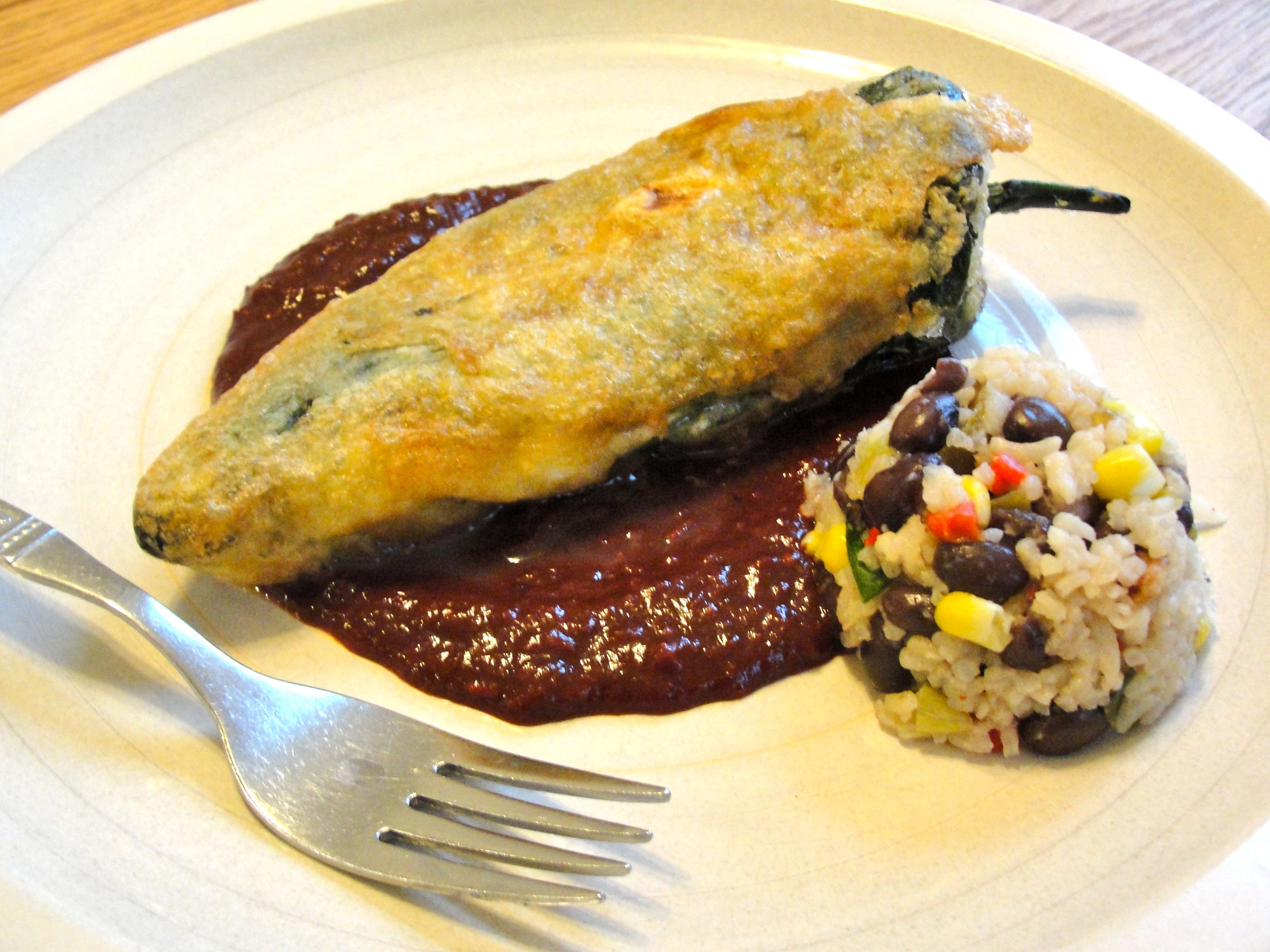
Chile Relleno de Queso with Ancho Chile Sauce and Scotch Bonnet Beans and Rice

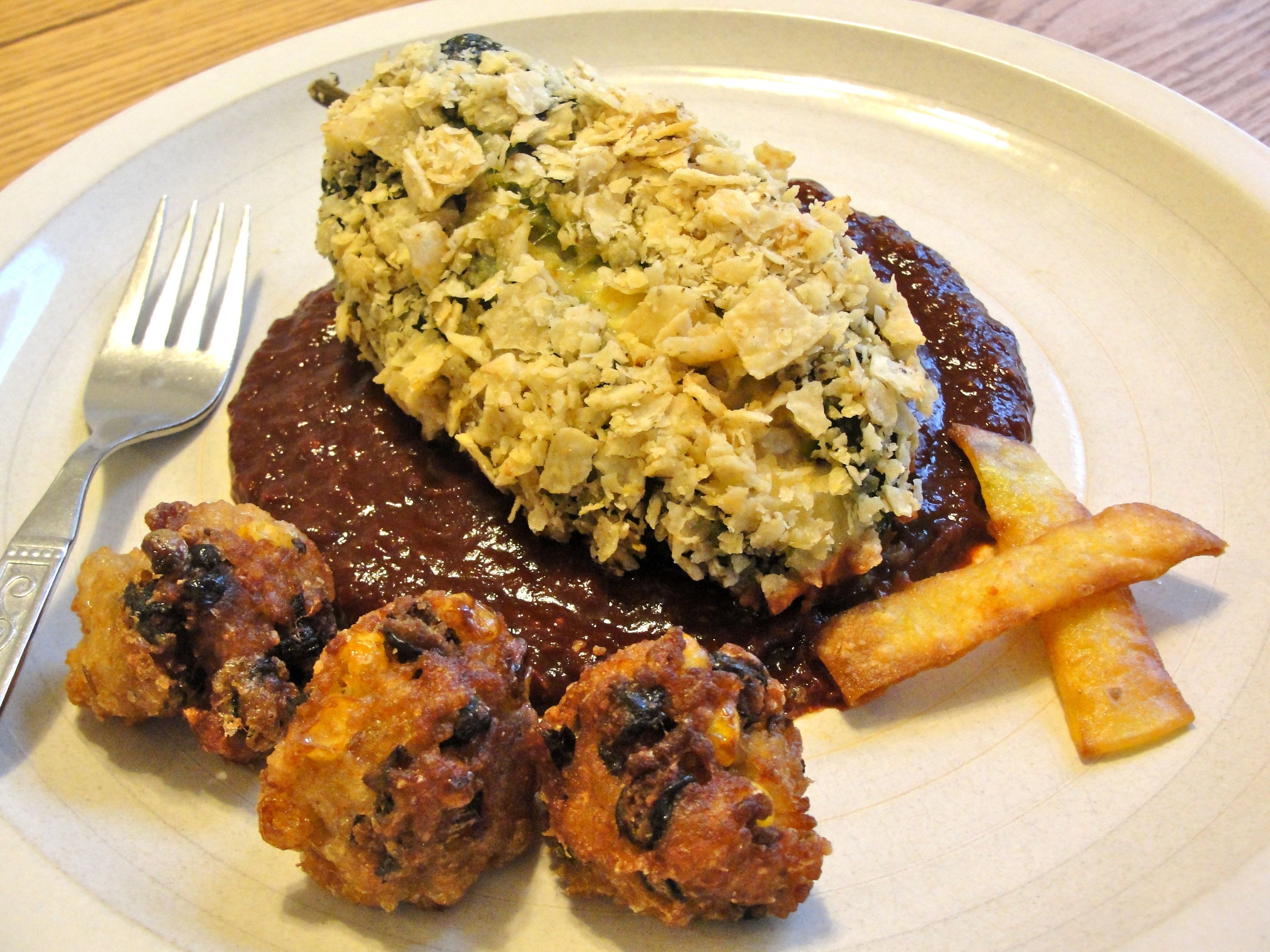
Baked Chile Relleno stuffed with Queso Fresco, Beans and Rice, atop Ancho Chile Sauce, accompanied by Rice Fritters

The ranting chef, in a recent post, asked, “Do you have a `go to’ test dish for the places you go?”
My favorite “go to” dishes for mexican restaurants are: (1) torta and (2) chiles rellenos.  I’d not made either of these at home, so now I’m tackling chiles rellenos.  In my experience, chiles rellenos are typically poblano peppers, stuffed with cheese, batter-dipped, and deep-fried to a golden brown.  As with other stuffed peppers, there are many variations involving the stuffing and the coating.  For instance, many years ago at a restaurant, I enjoyed a nice chile rellenos coated with crushed, multi-colored tortilla chips.  Since I mostly avoid deep-fried foods, that was a great alternative that, instead of submersing in oil, could be baked – like the relatively bland, but convenient bell-pepper-based stuffed peppers my mom used to make with ground beef, rice, and tomato sauce…  and, yes, I know tortilla chips are deep-fried.  But, while shunning explicitly deep-fried foods, I did also allow myself potato chips, but not french fries.  Whatever; live and let me live with my own innocuous delusions. :)

Last week I bought three fresh poblano peppers (about $1.50) and some queso fresco (about $7 for 12 oz. – seemed expensive, but that’s Whole Foods for you) and decided I would make each as a differently-prepared chili relleno.

Making chiles rellanos for the first time is non-trivial.  First, you’ll want an accompanying sauce or salsa.  Then, you’ll need to blacken or blister and peel the peppers (to remove the bitter skin), carefully clean and stuff them, coat them, and then cook them, preferably without the filling falling out and without the result looking disgusting.  I managed that on two out of three of the peppers I prepared: (1) a typical cheese-stuffed pepper, and (2) a baked, tortilla chip-encrusted pepper with a more interesting filling;  the third pepper we’ll appropriately name, “chile relleno not appearing in this post.”  (It will, however, be appearing on my plate of leftovers for dinner sometime soon, i.e., too ugly to post, but not too ugly to eat.  Full disclosure:  I waited too long to batter-dip it and the batter had lost its meringue-ness, and thus did not coat the pepper well.)

To accompany the chiles, I used an Ancho Chile Sauce that I had prepared in advance.  I liked the idea of matching the stuffed poblano with an ancho chile-based sauce, since the ancho chile is actually a dried, ripe poblano pepper.

Typical Chiles Rellenos ingredients:

  • large fresh green poblano peppers (2)
  • canola oil
  • queso fresco (~4 oz., crumbled)
  • all-purpose flour
  • eggs (3 separated, whites whisked until frothy and smooth, yolks carefully folded in)

As an alternative filling, I created a Scotch Bonnet Beans & Rice, since I wanted a spicy kick, as chiles rellenos are typically quite mild; I acheived a moderate level of heat by using just a single scotch bonnet pepper, with seeds and veins removed.

Baked, Tortilla Chip-encrusted Chile Relleno ingredients:

  • large fresh green poblano pepper (1)
  • queso fresco (~1.5 oz., crumbled)
  • scotch bonnet beans and rice (see below, or use another stuffing)
  • egg (1, whisked, as a wash)
  • tortilla chips (crushed, ~1/2 cup)

To get started, we need to blacken and blister the skin of the peppers as thoroughly as possible. This is so that we can peel them.  I used a combination of methods: directly placing them over the stovetop gas flame and turning them in a pan over high heat.  Previously I’ve done this under the broiler (turning frequently); in hindsight, I think the broiler works best.
Once blackened and blistered, place them in a plastic Zip Loc bag to steam and cool.

Blistering the Poblano Peppers for peeling

While the peppers are cooling, prepare the stuffing(s).

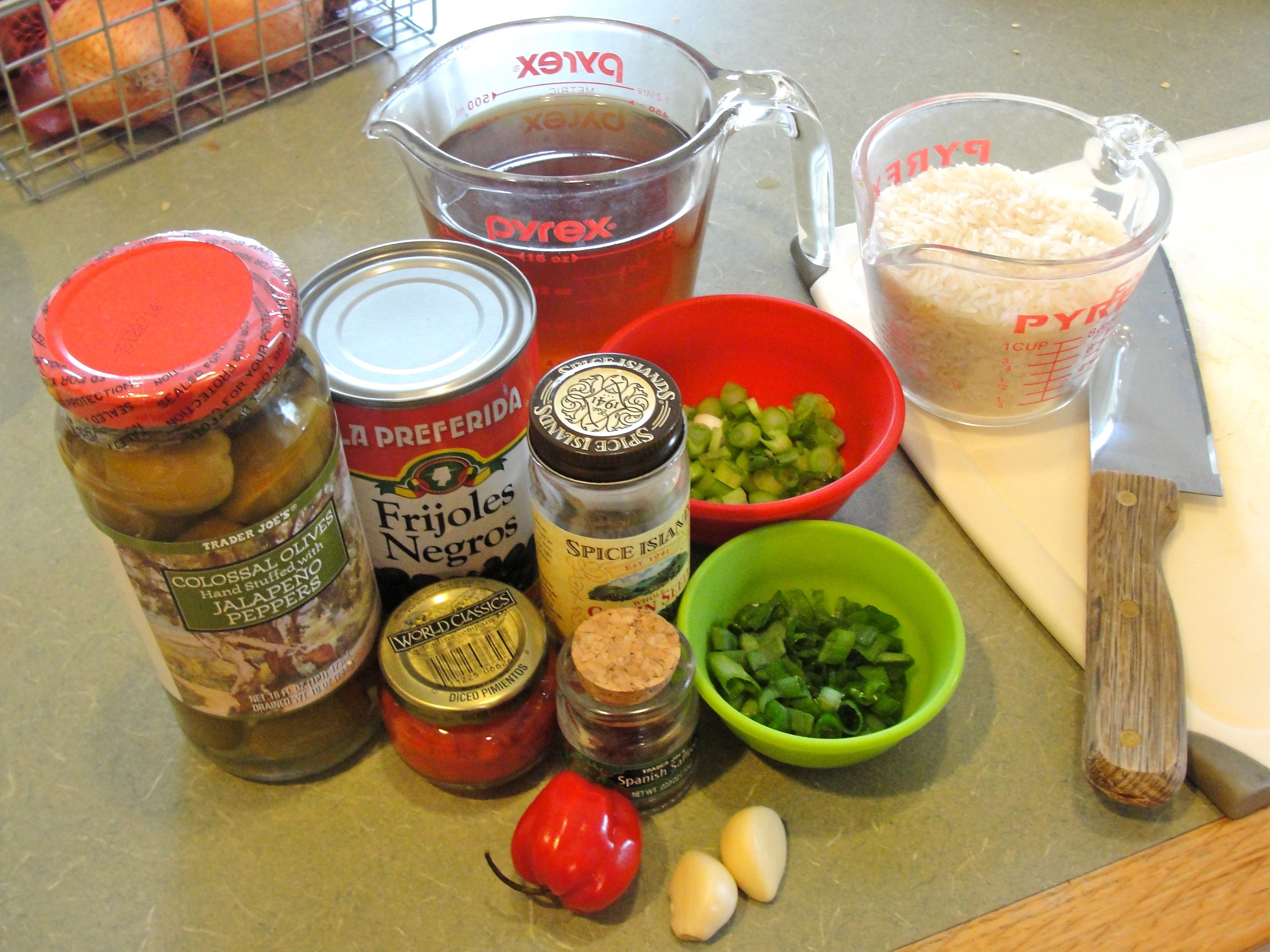
Scotch Bonnet Beans and Rice ingredients:

  • rice (I used 1 cup rinsed jasmine rice, because that’s what I had on hand)
  • water from reconstituted ancho chiles or soup stock (2 cups)
  • scallions (2 chopped, white and green portions separated)
  • black beans (1 can, rinsed and drained)
  • garlic (2 cloves minced)
  • sweet corn (frozen, ~2/3 cup)
  • pimento (2 oz.)
  • large green olives (~6, sliced, I used jalapeno-stuffed olives)
  • pickled jalapeno (1 T., minced)
  • scotch bonnet pepper (optional, 1, seeded, deveined, dry roasted, and minced as finely as possible, or substitute a habanero, jalapeno, or some other milder pepper)
  • cumin seed (1/2 t.)
  • saffron threads (optional)

Scotch Bonnet Beans & Rice Ingredients

I placed most of the ingredients (except for the beans and scallion greens) in a rice cooker, with the corn in the steamer basket, and cooked with the rice.

Cooking the Rice

When rice is done, toss in the steamed corn, black beans, scallion greens, and salt to taste; and using chopsticks; using chopsticks is a good tip if ever you need to mix fine ingredients into a moist or somewhat sticky rice because it won’t stick to the utensils too much.

Scotch Bonnet Beans & Rice for stuffing, as a side dish, and for rice fritters

Our simpler stuffing is the queso fresco.
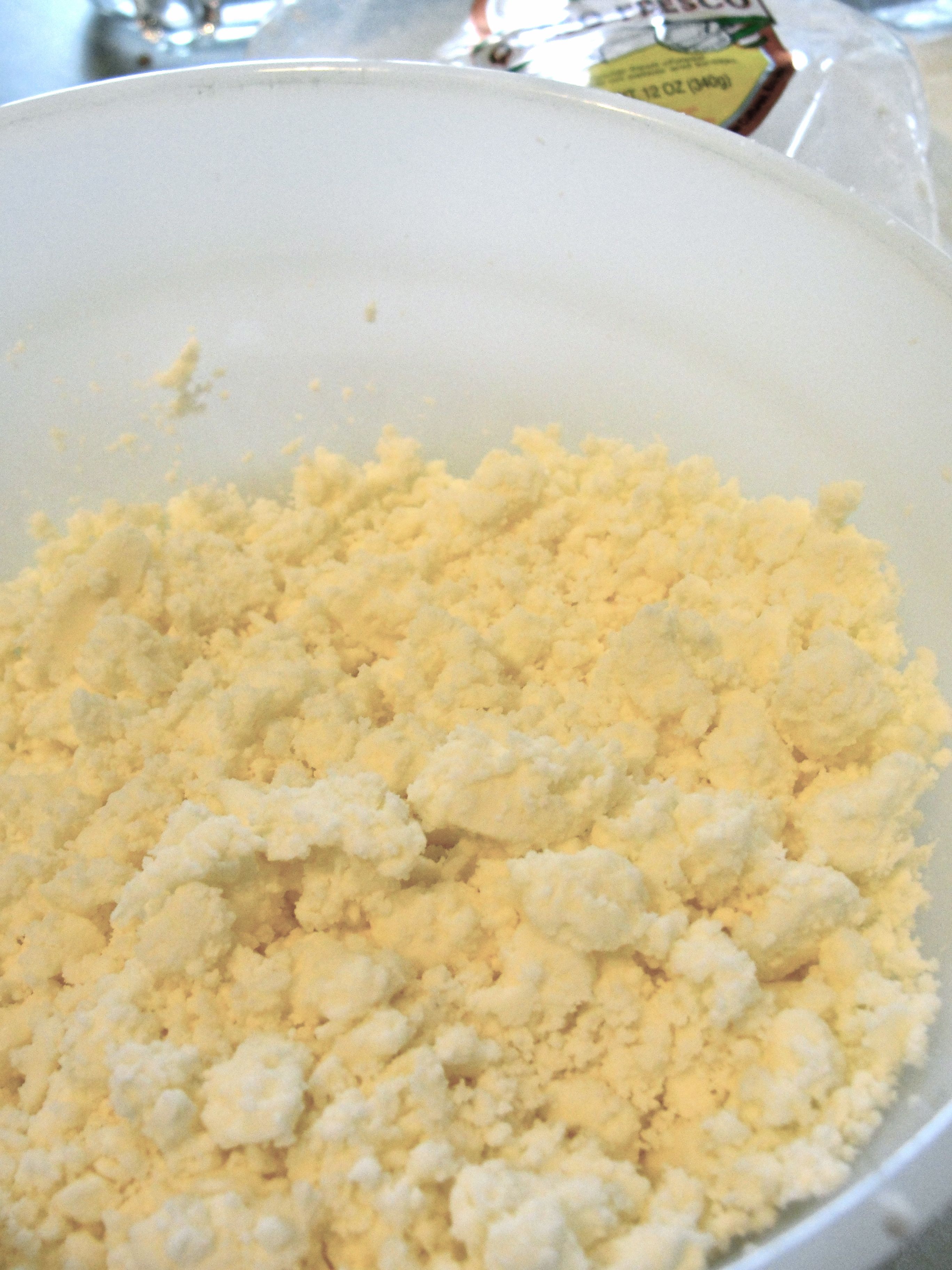
Crumbled Queso Fresco

When the peppers are reasonably cooled, carefully peel them, rinse them in water, cut a slit perhaps 2/3 down one side and carefully remove the seed bunch, any veins, and any loose seeds.  I leave the stem intact for handling and for presentation.

Deseeding and Cleaning Poblano Peppers

Next, carefully stuff the peppers as desired.  For some, simply fill them moderately with crumbled queso fresco.  For others, perhaps stir queso fresco in with the beans and rice to form a stuffing.

To bake peppers rolled in tortilla chip crumbs, first dip the stuffed pepper in an egg wash, then roll in crushed tortilla chips, and place in a greased baking pan.  Bake at 375°F for 45 minutes to 1 hour (occassionally check to be sure chips aren’t too brown), or partially bake (e.g., 1/2 hour) and store to reheat by baking later.

To fry peppers in oil, prepare the egg batter for the peppers by vigorously whip the egg whites with a whisk into a meringue consistency (a large metal bowl is best, but I don’t have one), then carefully fold the yolks in to mix evenly, but be careful not to overstir, which will cause the whites to collapse.
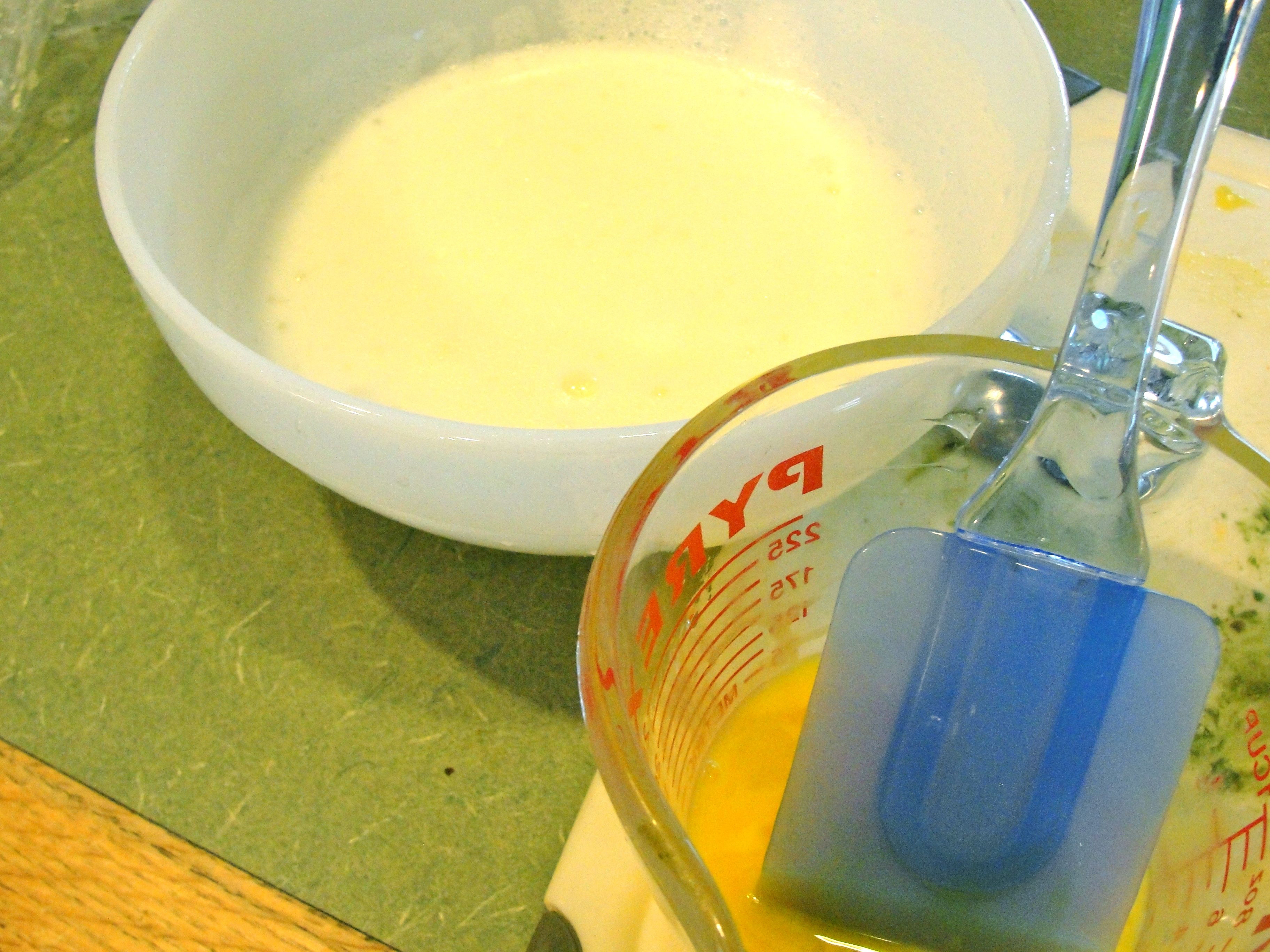
Whipped Egg Whites and Separated Yolks to be folded together for Batter.

For the peppers to be fried in oil, first coat them with flour.

Dipping a Stuffed Poblano in Flour before Egg Batter

Then dip them in the egg batter, and place them in hot oil, e.g., about 1/2 inch deep; I tested the oil temperature by frying some corn tortilla strips.  Be sure to adjust the temperature so that it sizzles when something is dipped in, but doesn’t cook so fast that it will quickly burn.
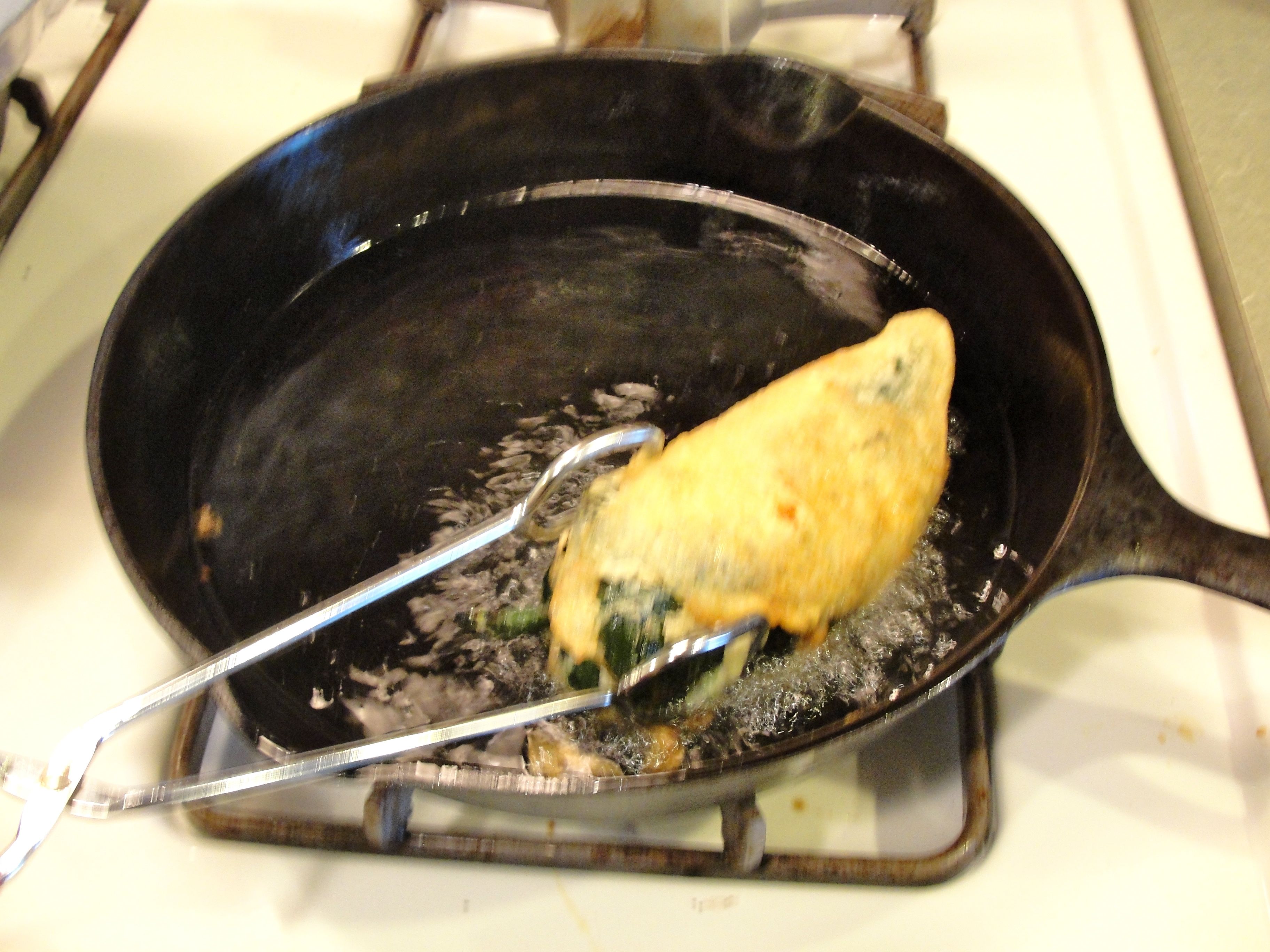
Blurry Action Shot: Frying Chile Relleno

Turn the peppers occasionally to cook on each side, being careful to avoid spilling the filling.  (Be particularly careful when cooking the side that was slit open.)
After frying, place on paper towels to absorb excess oil.

Plate the chile relleno atop a sauce or salsa, and accompany with a side, such as my scotch bonnet beans and rice.

Chile Relleno with Ancho Chile Sauce and Scotch Bonnet Beans & Rice

As an optional side, and since my beans and rice was a bit sticky, I formed small balls (~1 in.), rolled them in the egg batter and fried them in the remaining oil to make rice fritters.
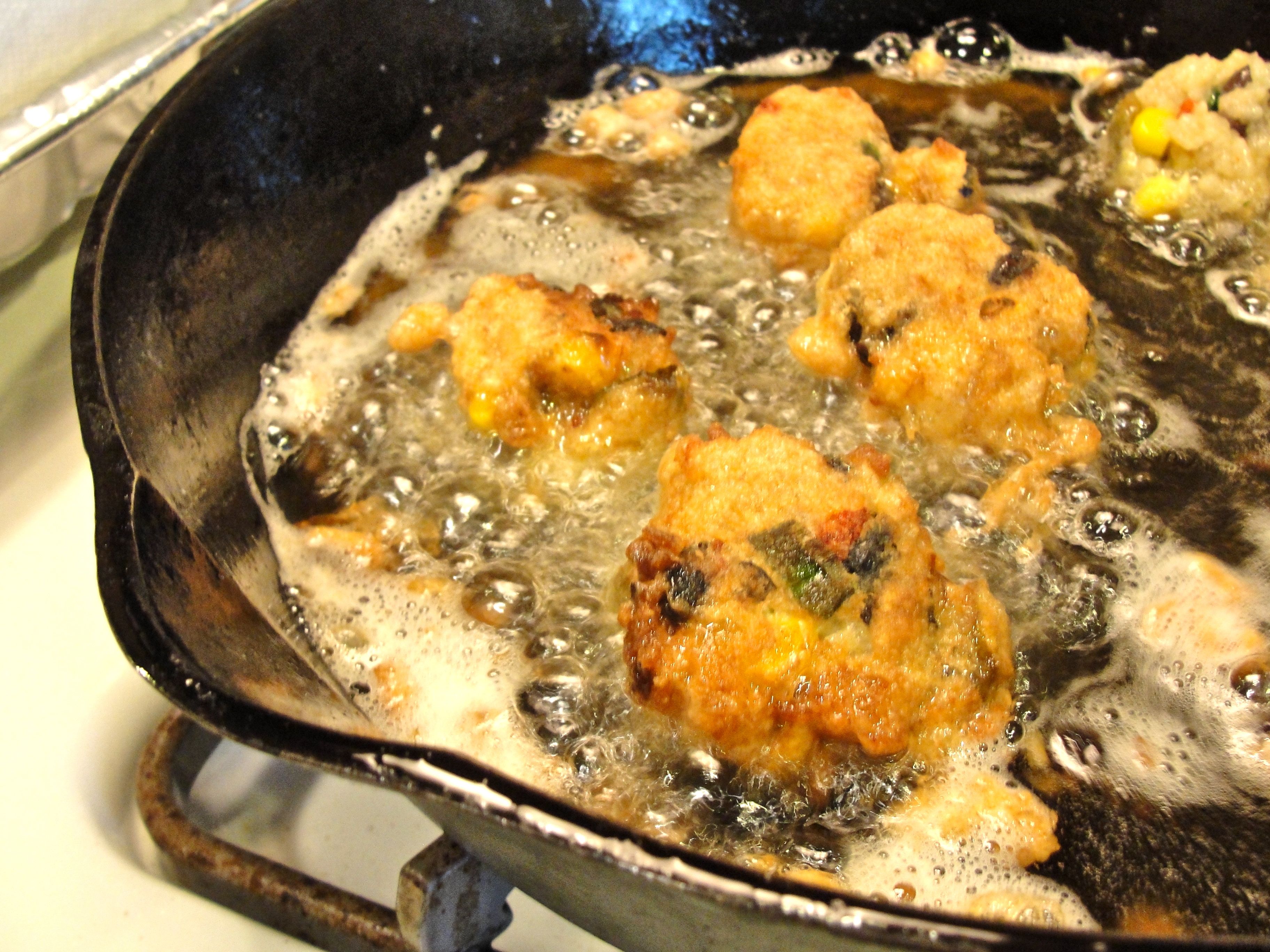
Frying Rice Fritters

Of the two chiles rellenos preparations (fried and baked), I was more pleased with the appearance of the typical fried chile relleno stuffed with cheese.

Lastly, while I kept this meal completely vegetarian, I can’t help but think that cooked chorizo would be a great additional ingredient to the stuffing. :)

This was a respectable first try, and I enjoyed the result, and even used some leftover rice and beans to make a breakfast burrito this morning.

Let me know your chiles rellenos tricks or tips!  This is definitely a recipe that benefits from experience.

Here are some recipes I consulted for ideas:

Oh ya, and here’s a non-mexican Stuffed Bell Pepper recipe you might like from Katja’s Kitchen. :)

Ancho Chile Sauce

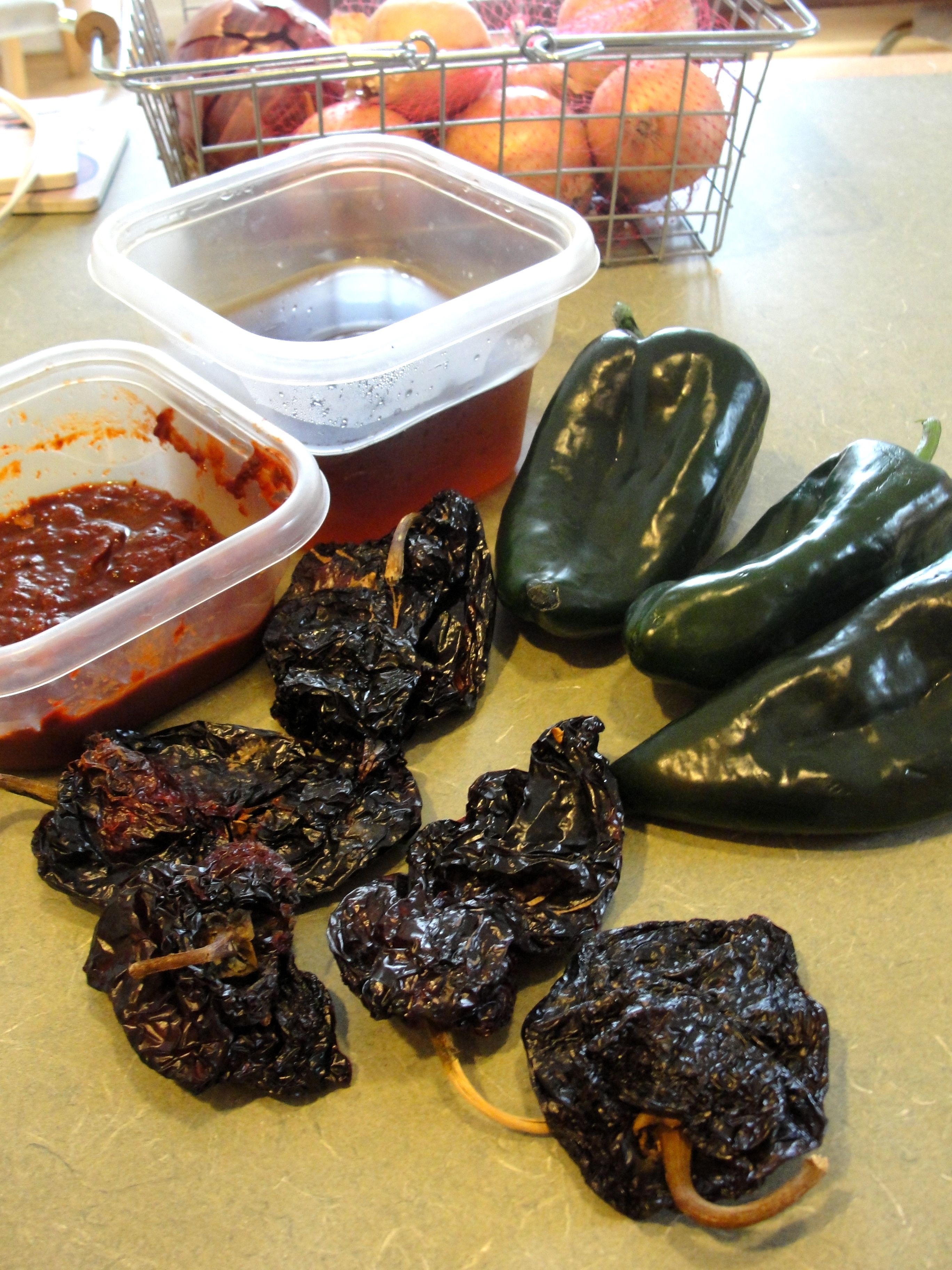
Ancho Chile Sauce, counter-clockwise from left: the finished sauce, the dried ancho chiles used to make it, the poblano pepper (that is called ancho when dried), the water left from reconstituting/steeping the ancho chiles used to make the sauce.

This past weekend I went to a great grilling party hosted by some friends from South Africa; they use the term “braai” the way Americans might use barbecue, and this party was a “bring ‘n’ braai,” i.e., bring what you’re going to grill and share.

I decided to make flank steak tacos, so I prepared this flavorful, dark red sauce as both a marinade for the steak and a taco sauce.

I have been interested in experimenting with the ancho chile for some time and to reproduce some of the great things I’ve had at mexican restauraunts; last week I stumbled across the peppers at an asian grocery for about for about $1.50 for a bag with enough to make this recipe 2-3 times.  The “ancho,” meaning “wide”, is a dried, ripe poblano pepper;  in the photo above I’ve also shown the fresh, green poblano, but it is not used in this recipe!  I guess the dried version is called “wide” because it typically appears wide and flat.

Sauce ingredients (to yield ~2 cups):

  • 4 large dried ancho chiles, pan roasted, reconstituted (save water), stemmed and seeded, rinsed, and coarsely torn
  • water from reconstituted chiles
  • roasted garlic, 6 medium-large cloves (e.g., pan roasted in skin, then peeled)
  • 1 small onion, minced
  • 2 T. tomato paste
  • 1 T. brown sugar
  • 2 T. Worcestershire sauce (or substitute another fish sauce or soy sauce)
  • 1 T. ground cumin
  • salt to taste

Begin by dry roasting the dried ancho chiles and the unpeeled garlic cloves in a pan on medium heat.  For such preparations, Chef Rick Bayless suggests doing this until the peppers just begin to smoke (flipping the peppers to do this on each side); he uses a spatula to push them flat to make better contact with the hot surface.  Roast the garlic cloves in their skin, turning occassionally, until it is tender then peel.

Dry Roasting Ancho Chiles and Garlic Cloves

Next, rinse the dried ancho chiles to clean them, and reconstitute them for at least 1/2 hour in warm water, perhaps 3 cups in a large pan or bowl; place a plate over them during this time so that the peppers stay submerged. (Alternately, you can steep them in boiling water.)  Then remove the chiles, save the water, and tear them over the sink and remove the seeds and veins, and rinse the peppers inside.

Lastly, simply combine the reconstituted chiles and other ingredients in a blender and blend until smooth; use the water saved from reconstituted chiles to acheive the desired sauce consistency.  If you have a blender with narrow-bottomed container , as I do, add the ingredients just a bit at a time with a bit of the water so that they will blend more easily.

An aside: save the rest of the water used to reconstitute the peppers!  Use it to flavor other salsa or rice, such as my Scotch Bonnet Beans & Rice!

If the sauce is too watery, reduce by simmering it in a pan until desired consistency.

Use the sauce as a marinade for flank steak, skirt steak, or other meats; apply it liberally to all sides and marinate for at least 1/2 hour, then get to grillin’!

The sauce can also be used as a dip for chips or to complement tacos and other dishes.

Chile Rellenos with Ancho Chile Sauce

Tonight it accompanied my Chiles Rellenos!
(That post is forthcoming; I’m just too tired to do it tonight.)

Here are some related recipes that I consulted: Ancho Chile Sauce, Red Chile Adobo SauceCarne Adobada, and Pumpkin and Ancho Chile Mole.

P.S. Yay for Pati’s Mexican Table: a wonderful program on PBS that I just discovered this past weekend!  This is a nice addition to one of my favorites: Rick Bayless’ Mexico – One Plate at a Time.

Peruvian Baked Chicken

Peruvian Baked Chicken

More properly, this could be called Peruvian-inspired Baked Chicken; not being a Peruvian and without access to native ingredients, this is a rough approximation that I prepared for myself and friends (4-5 servings).  My closest Peruvian friend was out of town, so the authenticity remains untested. :)

A second inspiration for this dish is my love the taste of habanero pepper, in spite of its sometimes overwhelming heat.

This recipe uses two very hot peppers; in fact, these two are the hottest peppers that I know to be used regularly in cooking recipes (100,000-350,000 scoville units). I chose one habanero and one scotch bonnet, a related and similarly hot pepper.

Habanero and Scotch Bonnet Peppers

Be extremely careful when handling these peppers, once cut; if mishandled, you may find yourself in pain for hours. If you start to feel the tingling heat in your fingers from touching the pepper, you can dip your fingers in milk to sooth them, and/or use a toothbrush to clean them if you get the oils under your fingernails. Some people like to wear latex (or similar) gloves, however, I manage to handle these by just being careful to only touch the waxy outside of the pepper, and use only utensils to touch the insides when cutting, seeding, removing the veins and, mincing.

For this dish you could either use one whole chicken, cut up, or 4 leg quarters, as shown here.
The first step (a day or two in advance) is to prepare a marinade and to marinate the chicken (e.g., in a large, strong Zip Loc bag) for 8 to 40 hours.

Marinade ingredients:

  • olive oil (3 T.)
  • mint leaves (1/3 cup)
  • smoked paprika (2 t.)
  • cumin powder (1 T.)
  • garlic (6 large cloves, minced)
  • scotch bonnet pepper (1, seeded and veins removed, minced)
  • habanero pepper (1, seeded and veins removed, minced)
  • salt (1 T.)
  • ground pepper (1 T.)
  • brown sugar (1 T.)
  • crushed dried oregano with buds (2 t.)
  • fresh lime juice (1/4 cup)
  • lime zest ( 2 t.)

Combine marinade ingredients and thoroughly blend in blender or food processor.

Use a spoon or bowl scraper to apply the marinade to the chicken.  Loosen, but do not remove, the skin, and be sure to put the marinade both between the chicken meat and the skin in addition to on the outside of the skin and pieces.  (If you use less hot pepper, you could certainly apply the marinade by hand.)

To bake the chicken, place it on a broiler pan, with water in the bottom (to keep rendered fat from burning and smoking), and bake for approximately 1 hour at 375°F.  If necessary to crisp the skin, rub or spray chicken with oil and finish under the broiler.

Given that I meant the chicken to be somewhat spicy, while it was baking, I prepared a soothing cream sauce with cilantro, lime and ripe avocado.

Sauce ingredients:

  • sour cream (1/2 cup)
  • mayonnaise (3 T.)
  • milk (~1/3 cup, to desired consistency)
  • cilantro leaves (1/2 cup)
  • balsamic vinegar (1 t.)
  • avocado (1, ripe)
  • juice of fresh limes (~3, to taste)
  • salt (to taste)

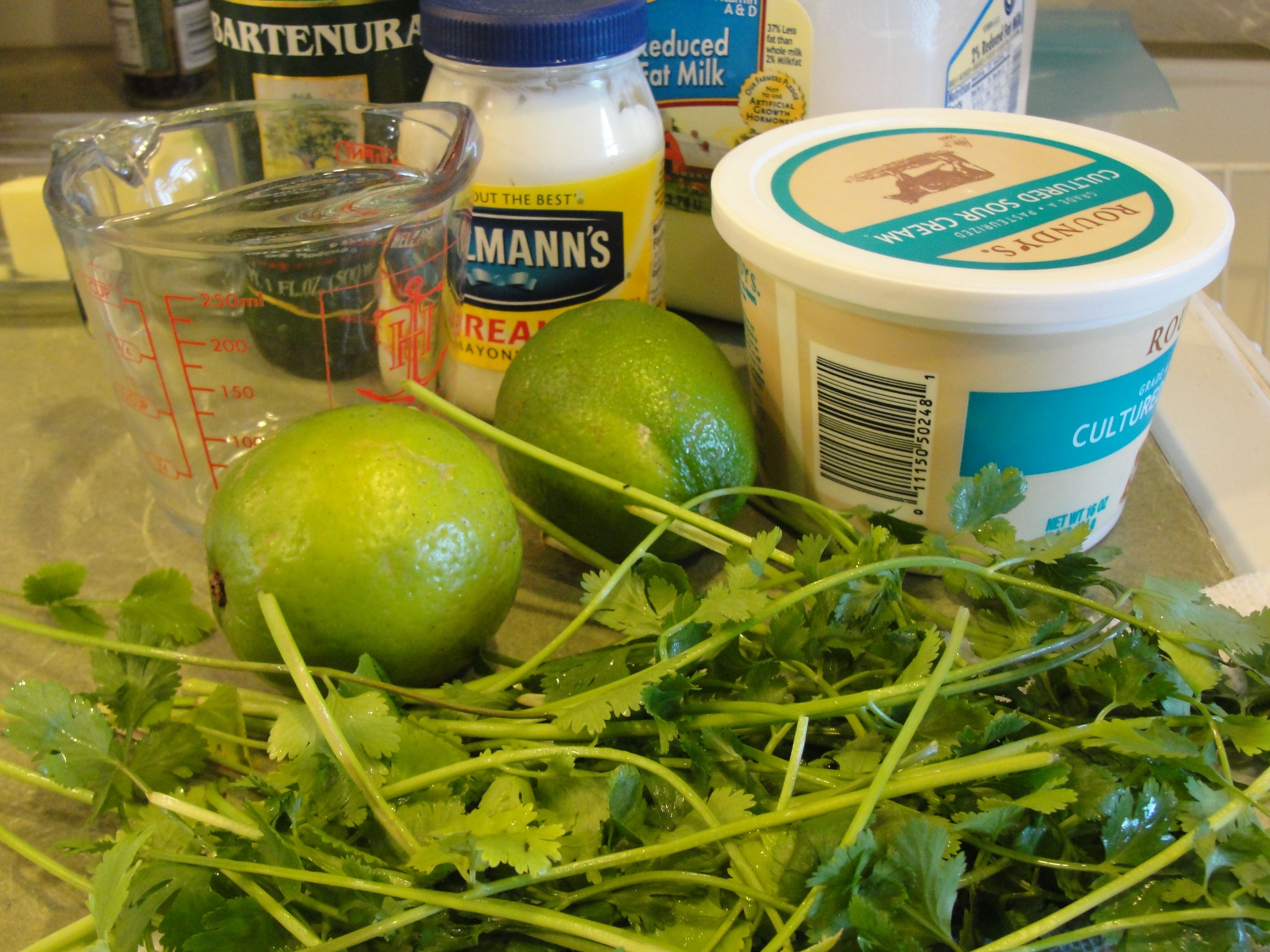
Cilantro Lime Avocado Sauce Ingredients

Combine sauce ingredients in a blender and puree.  (Adjust amount of milk to achieve desired consistency.)

Abstract #1: Sauce Ingredients in Blender

Once baked, I cut each leg quarter into 3 pieces: a leg, and two thigh pieces.  Use a chef’s knife or cleaver so that you can cut through the bone.

Peruvian Baked Chicken Leg Quarters

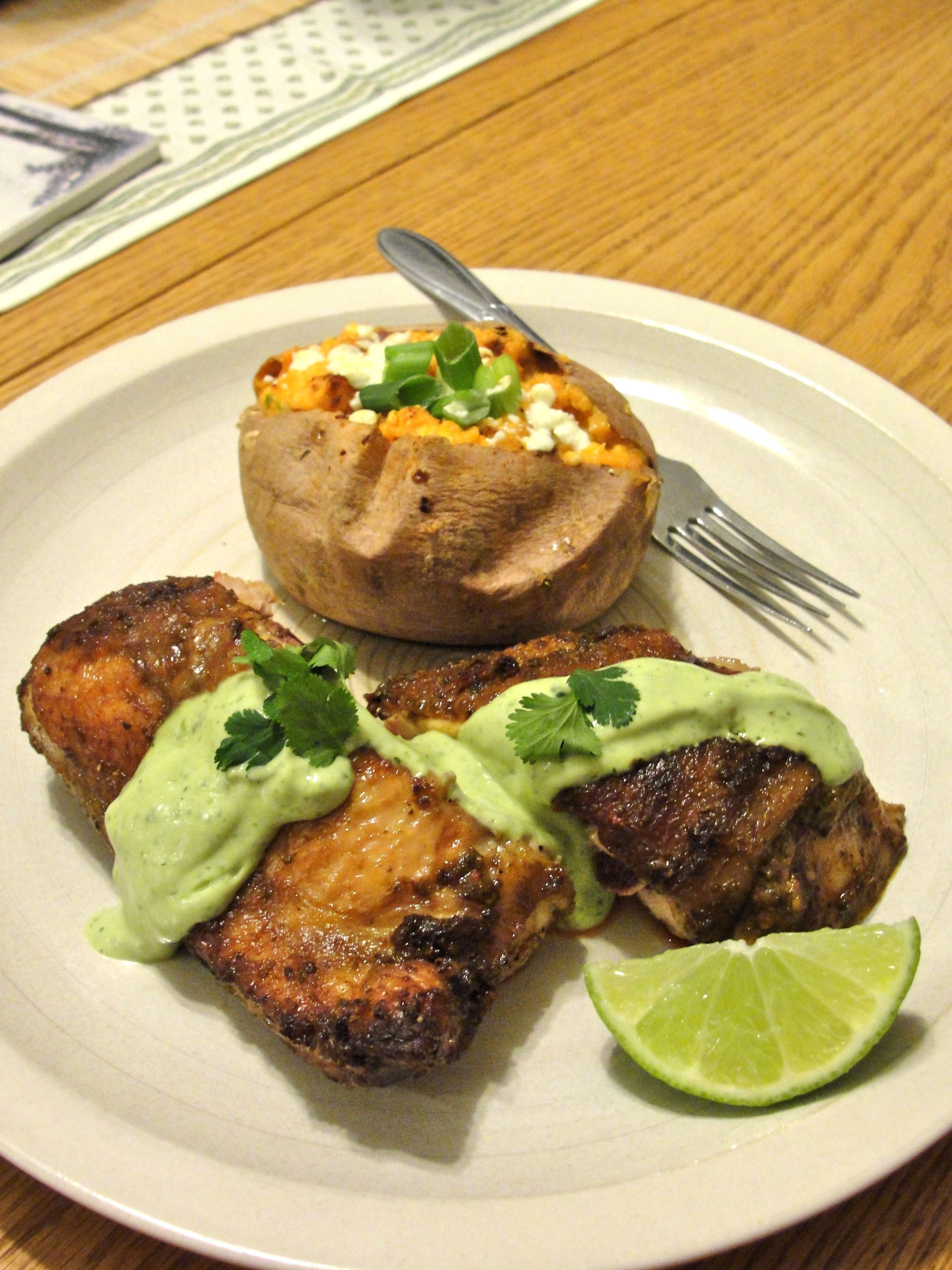
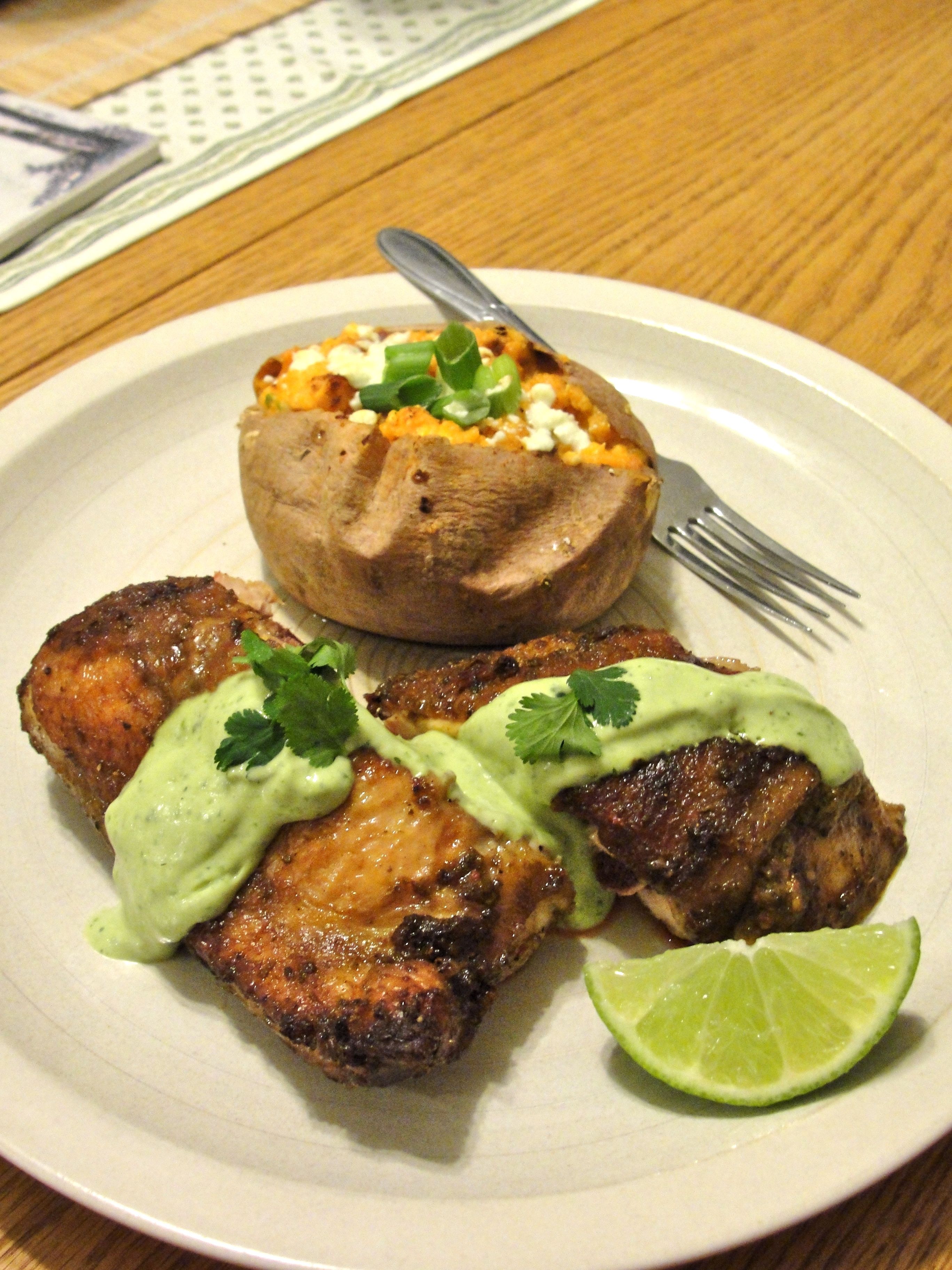
I served the chicken pieces, two per guest, topped with the sauce and accompanied by a Twice Baked Sweet Potato.

Overall, this dish was pretty good and fairly mild or just approaching what many Americans might call “medium” in heat.  Next time I’ll vary the pepper (perhaps adding a bit more) and limit the amount of mint so that it doesn’t dominate the flavor.  I used 1/2 cup of mint leaves (before chopping); the amount (1/3 cup) in the marinade ingredients above is my revised suggestion.

Here are the recipes that I used as bases for this dish:

UPDATE (June, 2015):

I wanted to spice it up even more so this time also added the following to the marinade:

  • An additional habanero pepper (2 total, seeded and finely minced)
  • 1 teaspoon cinnamon
  • 1 teaspoon allspice
  • apple cider vinegar and water until desired consistency

This worked well, and still wasn’t too much spice for 8 chicken thighs.

Twice Baked Sweet Potatoes

Twice Baked Sweet Potatoes

Here’s a delicious side item that I made them to accompany Peruvian Baked Chicken.
It is said that Peru is an incubator of vegetable genetic diversity, with some 8000 varieties of potato alone (although not so many are sold as produce) and the Sweet Potato being one variety found to have been there for thousands of years.

Ingredients (to serve 4):

  • sweet potatoes (4, medium to large, well-shaped)
  • scallions (2, whites minced, greens chopped coarsely for topping)
  • butter (1/2 stick)
  • egg yolk (1)
  • queso fresco (6 oz., crumbled, with some reserved for topping)
  • paprika
  • ground pepper (to taste)
  • salt (to taste)

Wash the potatos and scour, but do not remove skin, except were blemished; also remove and root fragments.

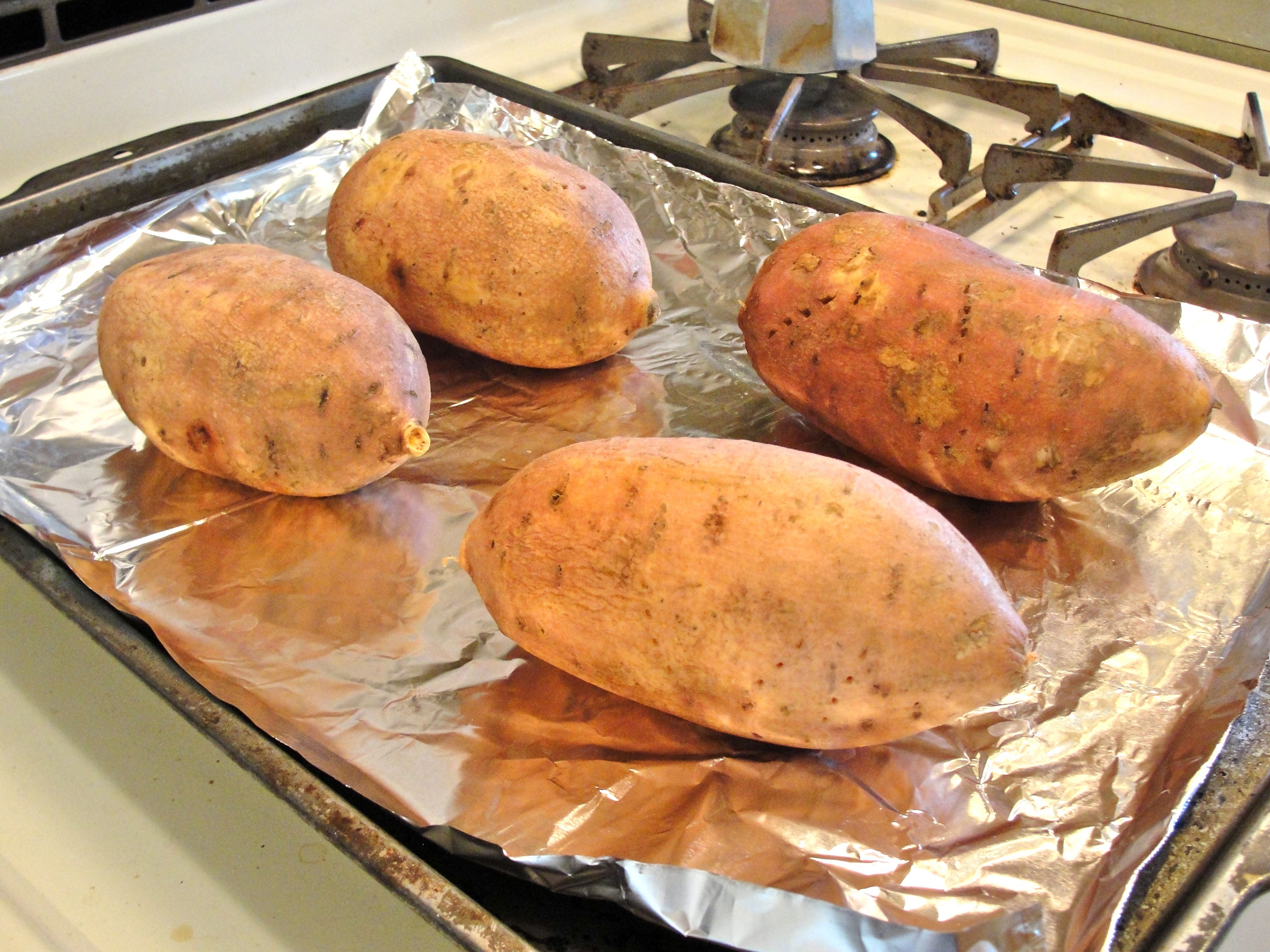
To prepare for baking, poke holes in the potatoes with a fork and place them on a foil on baking sheet or jelly roll pan; the foil will prevent burning and mess from the sugary syrup that may drip from them while baking.

Bake the potatoes until tender, 1 hour or perhaps slightly more at 400°F.

Sweet Potatoes, prepared for baking

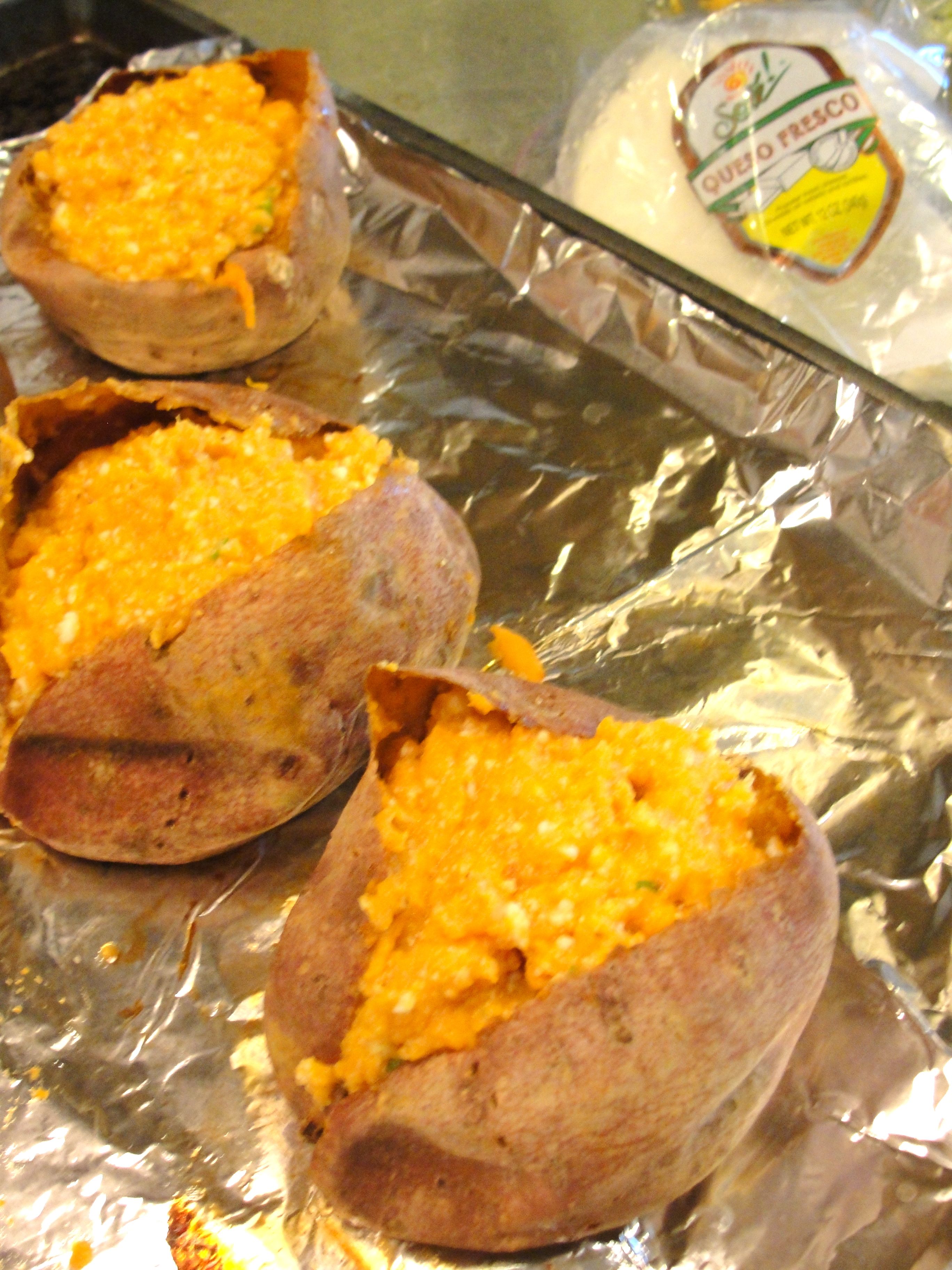
Once baked, allow the potatoes to cool somewhat, and carefully cut a slit in the top of each potato and use a spoon to scoop out the potato, being careful not to tear the potato skin.

In a bowl or pot (such that you might prepare mashed potato in), combine potato, butter, egg yolk, most of the queso fresco, pepper, and salt, and mash until smooth and well combined.  (Queso fresco is crumbly by nature, so it will not completely mix in with potato.)

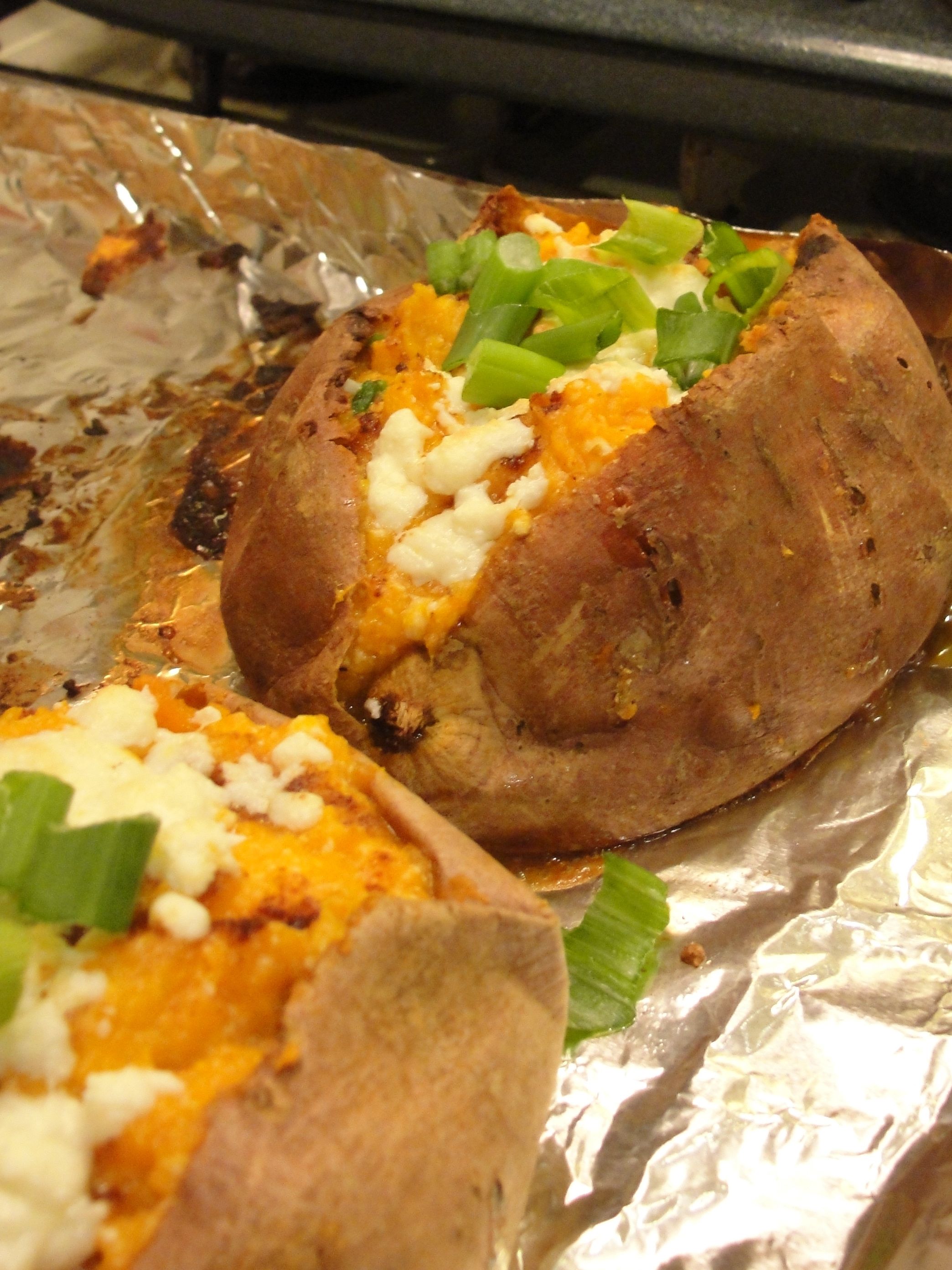
Carefully refill the potato skins with the potato filling.  Top the potatoes with a sprinkle of paprika and a bit of crumbled queso fresco, and return to the oven to melt the cheese, and perhaps just slightly brown the potato tops.

Stuffed Sweet Potatoes, preparing to return to the oven

Remove from oven and top with scallion greens to serve these sweet and delicious potatoes, perhaps as I did with Peruvian Baked Chicken!

Twice Baked Sweet Potato accompanying Peruvian Baked Chicken

Here’s a similar recipe that I used as a reference (I prefer using queso fresco or feta rather than cream cheese): Stuffed Sweet Potatoes

Coconut, Peanut, & Pea Shoot Salad

Coconut, Peanut, and Pea Shoot Salad

Here’s a delicious salad that I arrived at by accident… and, despite having two nuts in its name, it contains no nuts, since coconut is not a proper nut and peanut is a legume or bean!

I was planning to make Tom Kha Talay, but when I opened the can of what I thought was coconut milk, I found that I had bought a can of young coconut meat instead. No problem, right?

If you’ve ever bought a young coconut, often served in China-towns as a coconut water beverage, then you’re probably familiar with the tender, sweet meat that lines the young coconut cavity.  The canned version I bought is the same, but in a sweet sugar-based syrup.

So, what to do?  I still had a pile of pea shoots for a salad to accompany the soup… how about adding the sweet coconut meat to a soup and a salad?

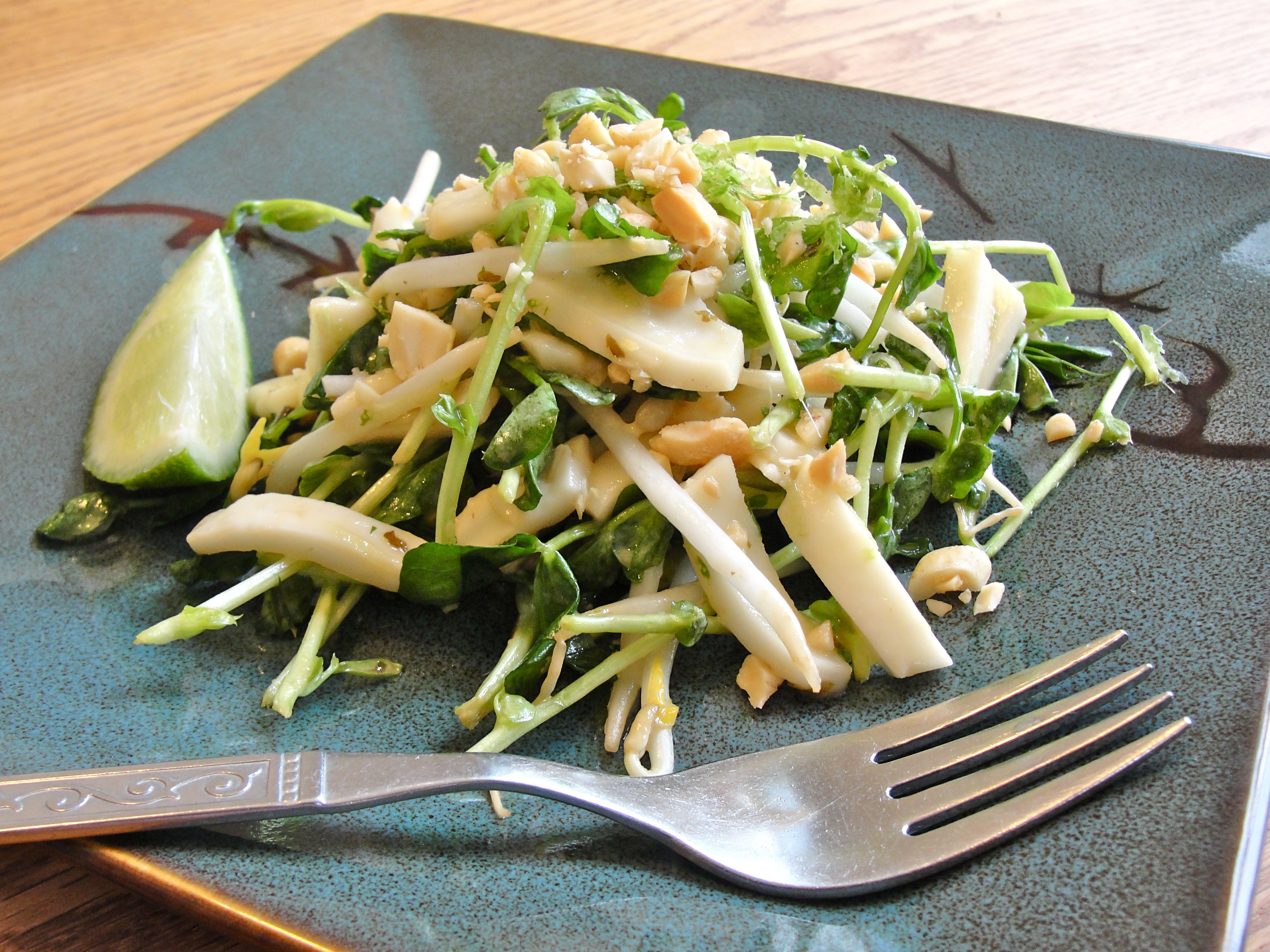
Here are the salad ingredients: pea shoots, mung bean sprouts, sliced young coconut meat, chopped roasted, unsalted peanut, tossed with a modest amount of Trader Joes’ Goddess dressing and a dash of fresh lime juice, and topped with more chopped peanut and lime zest.

As a fairly quick lunch, a number of the ingredients are off-the-shelf from the store.
If you haven’t had Trader Joe’s Goddess dressing, it is an oil and vinegar-based dressing with a delicious flavor dominated by soy, tahini (sesame), and garlic.

Prepared ingredients

For my  lunch, the salad was accompanied by Tom Yum Goong, made from store-bought Tom Yum Paste, homemade fish stock, diced potato, sliced carrot, sliced scallion, chopped green cabbage, quartered baby bella mushroom, chopped fresh cilantro, peeled shrimp (from frozen, raw), and chopped young coconut meat.

Tom Yum Goong with Coconut, Peanut, and Pea Shoot Salad

Next time you’re in an asian grocery, pick up some young coconut, and give this great salad and/or soup a try!

Asian Fish Tacos

I imagine you’re thinking, “Wow, Dave hasn’t made any asian dishes in a while…”
Not true.

Well, following my visit to no less than four grocery stores today, I am prepared to soon embark on new culinarily adventures, so I’m using up some of these fresh ingredients.

Asian Fish Tacos

I absolutely love fish tacos, thus made up these asian-fused-with-Tex-Mex fish tacos for lunch.
Typically fish tacos consist of three components atop corn tortillas: fish, a cabbage slaw, and a sauce.

For one serving (3 tacos), I first prepared a slaw from the following ingredients (approximately equal parts of the first 3 vegetables):

  • napa cabbage (3 leaves, green separated from white – see photos below, greens finely sliced/shredded)
  • carrot (1 medium, julienned)
  • bean sprouts (a small handful)
  • scallion greens
  • garlic (1 clove, minced)
  • rice vinegar (~2 T.)
  • hoisin sauce (~2 t.)
  • sesame oil (just a splash)
  • toasted sesame seeds or chopped toasted pine nuts (I used the latter)
  • lime zest (~1 t.)


Dissolve the hoisin sauce in the rice vinegar and toss with the rest of the slaw ingredients and let sit until needed.

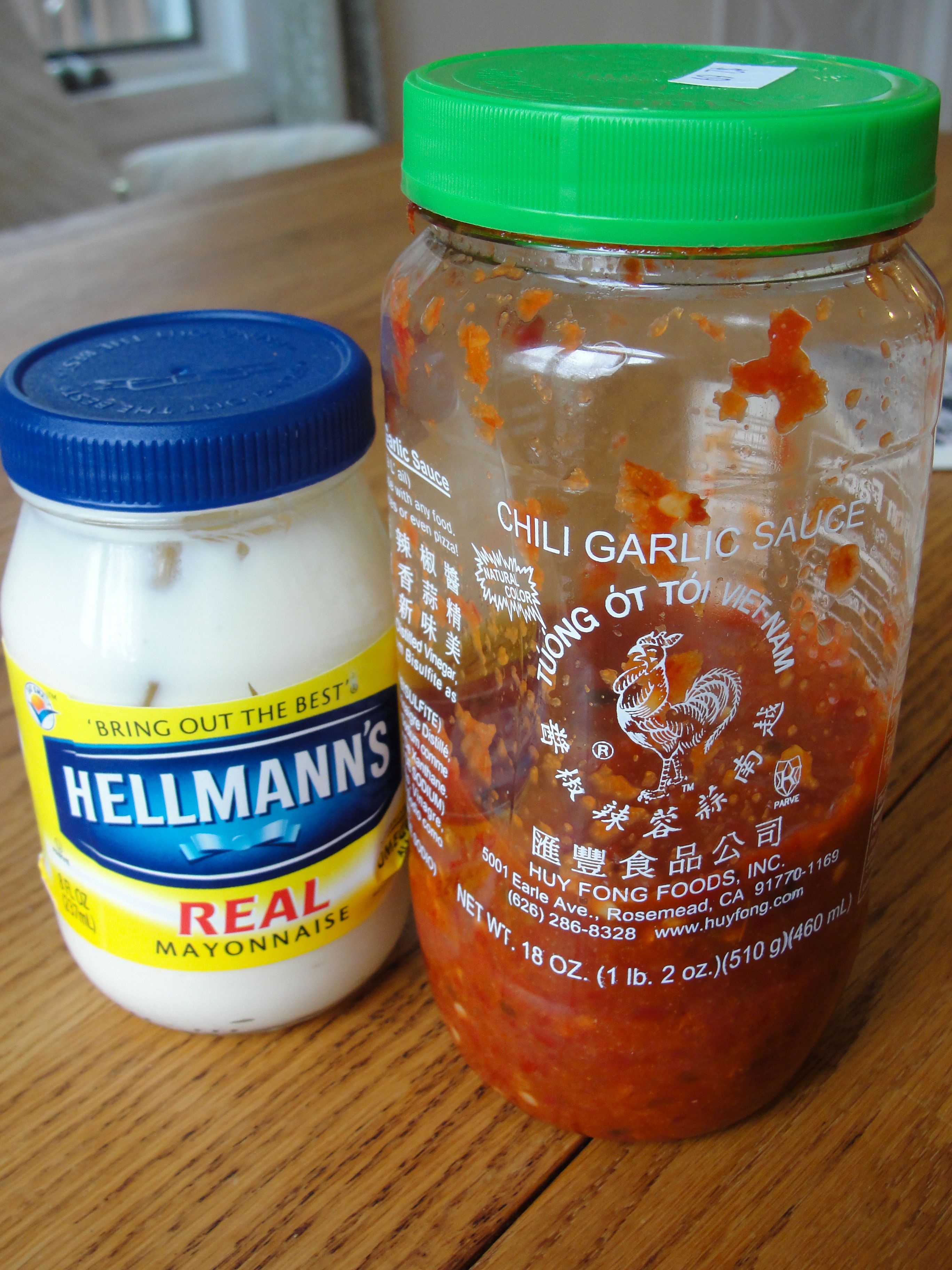
For the sauce, simply mix equal parts of mayonnaise and chili garlic sauce.

I used about 2 t. each, per serving (i.e., 3 tacos) and taste-tested it… I think I decided to add half again as much chili sauce.  OK, that’s easy!

Chili Garlic Mayonnaise

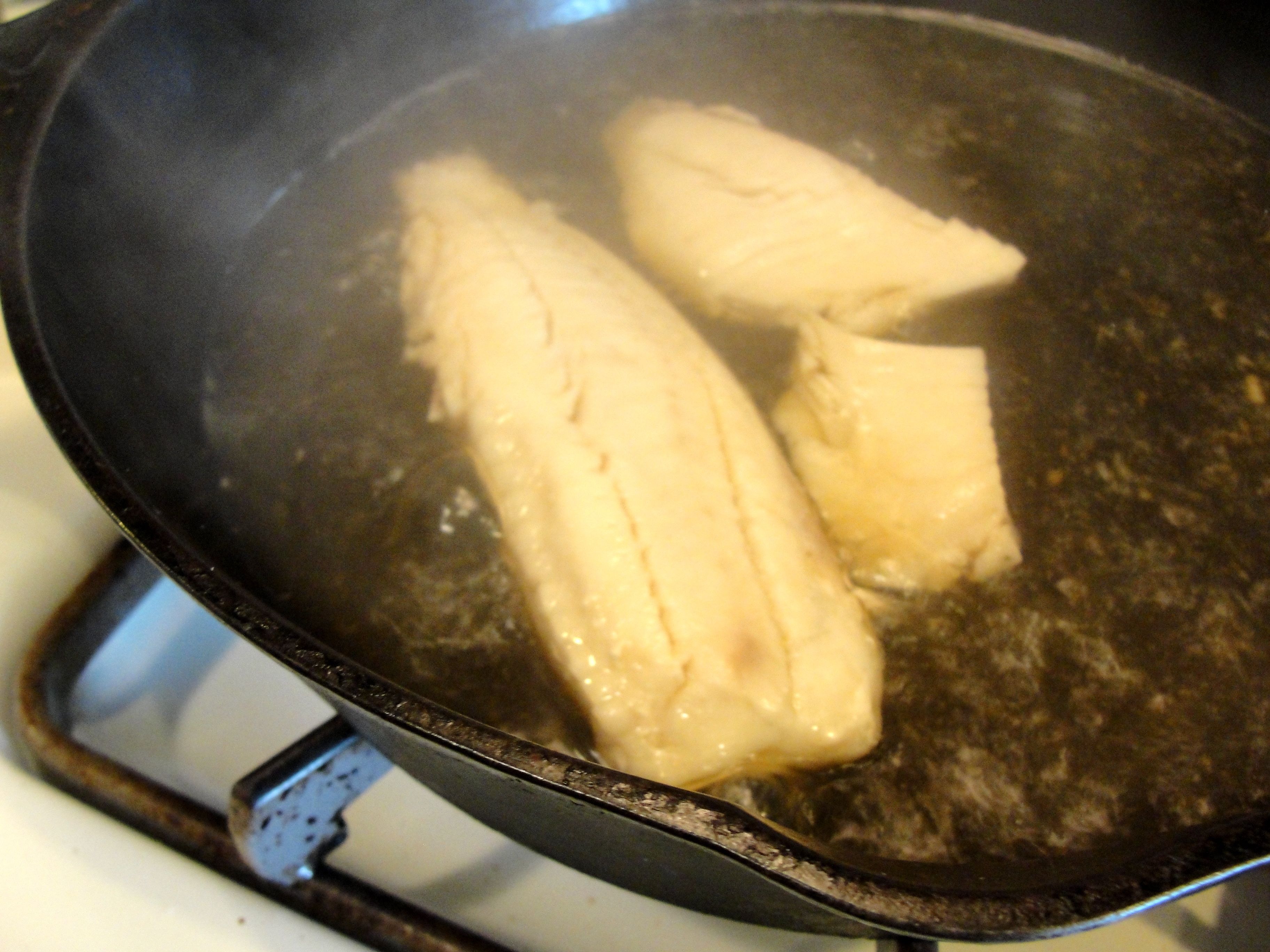
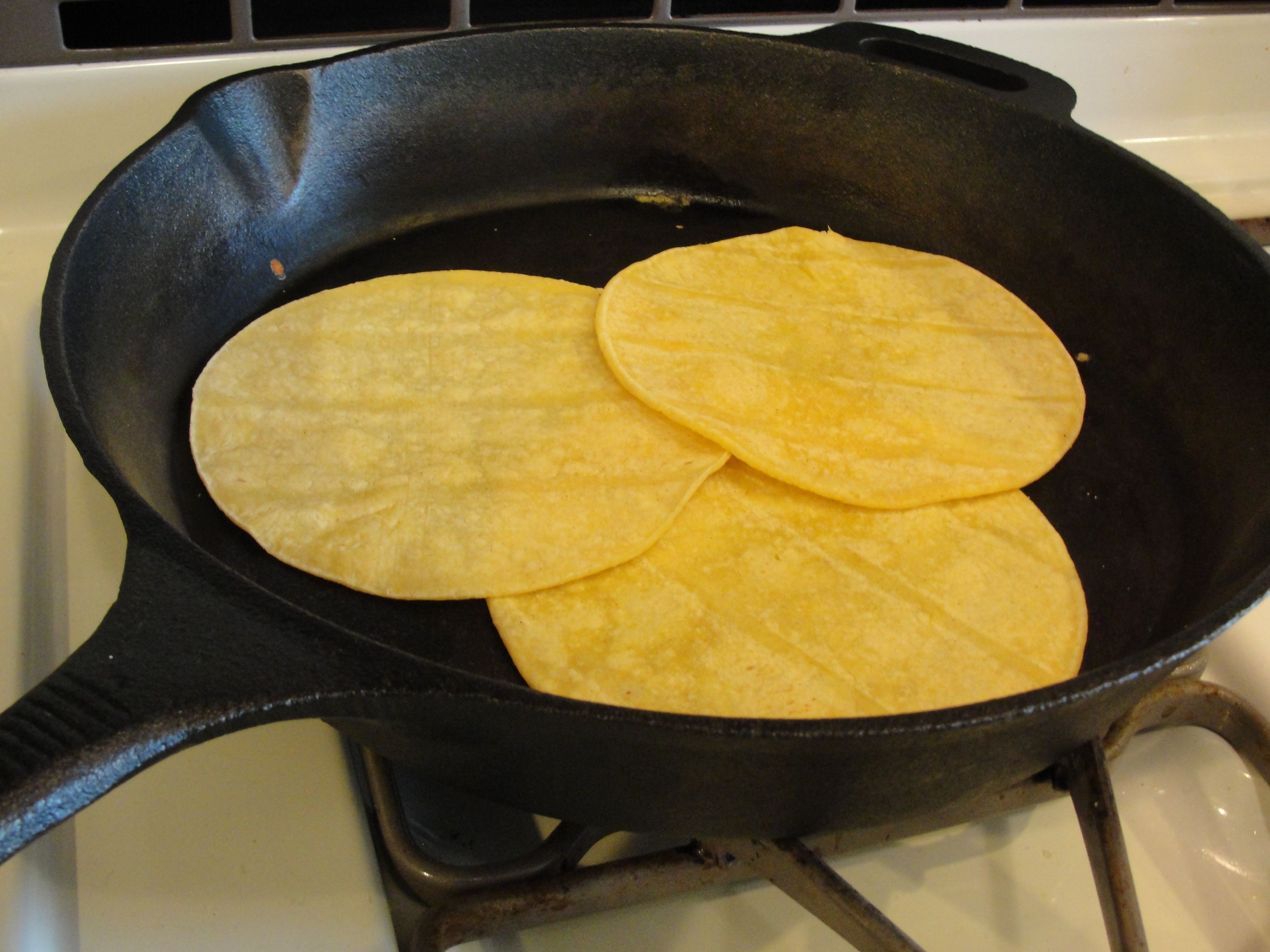
For the fish, I chose a tilapia fillet (from frozen, thawed in water), and poached it in a salmon-and-vegetable-based fish stock along with a couple teaspoons of soy sauce.  Here, I had just separated some pieces to test for doneness (i.e., if it will flake apart.)  Concurrently, I warmed corn tortillas in a skillet, and then wrapped them in a towel; this keeps them from getting wet underneath, e.g., if set on a plate when they’re very warm.

Poaching tilapia in fish stock

Warming tortillas

Lastly, I assembled the tacos, topped with a dab more of chili garlic sauce and, as you can see, placed “points” of the white portion of a napa cabbage leaf under each taco.  While intended for presentation, this worked out nicely to support the taco in hand; otherwise, one often must resorts to using two tortillas per taco so that they don’t break when the moist ingredients are placed on top.

Napa cabbage "point."

These tacos were easy and delicious.  They’d probably be nice with mu shu pancakes or flour tortillas as well.

Egg Foo Young

Egg Foo Young

Here’s a simple Chinese classic for breakfast, or anytime, and a welcome alternative to an omelet or the same old scrambled egg.

Egg foo young always reminds me of my father, long passed-away.
When I was a child, my parents weren’t adventurous with food, but once in a while we’d get take-out Chinese food and I recall them always getting a box with egg foo young in gravy.  My dad didn’t believe in delivery, so it was always a treat to ride with him to pick up the food.  (This was probably also a welcome respite for my mom waiting at home.)  My dad had developed a rapport with the restaurant owner, and they would joke and laugh.  This often resulted in something extra for free and I was intrigued by their friendship and tiny bit of human color and cultural diversity in the midst of our whiter-than-white part of the midwest.

Anyway, I never order egg foo young when I’m eating out now, so it’s possible that I haven’t had it in decades – until this afternoon.

For this dish I made two servings of the following ingredients: eggs (4, beaten, with a touch of salt and pepper), whole bean sprouts, finely chopped scallion, chopped baby bella mushroom, and finely shredded napa cabbage.

Mix those ingredients in a bowl, measure out a half cup per patty, and poor slowly into a generous amount of hot canola oil, between 1/8″ and 1/4″ deep, in a fry pan over medium-high heat.  Immediately use a fork to pull the egg at the edges toward the center, so that the patty doesn’t spread too thin.  Cook perhaps 2 minutes, then carefully flip the patty over and cook the other side likewise, until the egg and ingredients are cooked in the center.  Remove patties and drain on paper towels.  I made 2 patties at a time, for a total of 4 patties.

Meanwhile, prepare a sauce or gravy in a separate pan;  combine a stock (1/2 cup, e.g., from water and chicken bouillon granules), brown sugar (1 t.), soy sauce (~1 T.) hoisin sauce (~1 T.).   Heat this mixture, stirring to dissolve ingredients, then add corn starch slurry; to thicken sauce, heat just to a boil while stirring then remove from heat.

I served each patty atop a bed of pea shoots, then topped it with sauce and scallion greens.

Leftovers?  No problem – make a St. Paul Sandwich!

Here are some recipes I consulted:

Sesame Shrimp with Bean Thread Noodle

Sesame Shrimp with Bean Thread Noodle

Here’s a delicious stir-fried noodle dish with shrimp, inspired by similar dishes at a local Thai restaurant.

Ingredients (for 2):

  • bean thread noodle (2 servings prepared, i.e., soaked in warm water or lightly boiled)
  • raw shrimp, peeled and tails removed (from frozen, perhaps 8 per serving for 18-24 count-sized shrimp)
  • baby bella mushroom, quartered (perhaps 6 mushrooms)
  • bean sprouts  (~1 cup)
  • scallion (one per serving, white portion: finely chopped, greens: large diagonal pieces)
  • minced garlic (2 cloves)
  • canola oil (~1 T.)
  • sesame oil
  • toasted sesame seed (~ 1 T.)

For sauce:

  • fish sauce (~2 T.)
  • oyster sauce (~1 1/2 T.)
  • lemon juice (~1 1/2 T.)
  • honey (~1 t.)
  • chili garlic sauce (~1/2 t.)
  • water (add to prepare ~1/2 cup sauce in total, stir to dissolve honey)

In a pan on medium-high heat, begin stir-frying shrimp in oil, then add white scallion and garlic, and then mushroom.  When shrimp are nearly cooked (perhaps 2-3 minutes), add 1/2 of the sauce (or earlier to prevent garlic from browning), stir, and add bean thread noodles and stir.  Add remaining sauce, bean sprouts and scallion greens.  Stir thoroughly and remove from heat when bean sprouts are only slightly tender but not limp.  Sprinkle sparingly with sesame oil and top with sesame seed.

Plate and garnish with a spoonful of chili garlic sauce and fresh pea shoots!

Fresh Spring Rolls with Shrimp

Fresh Spring Rolls with Shrimp

Tonight I celebrated our ridiculously early spring with these tasty fresh spring rolls for friends!

This is another common restaurant treat that can be easily reproduced in your own kitchen.

The rolls were prepared in moistened rice paper (e.g., 22cm diameter, see video below for wrapping demonstration) with the following ingredients: napa cabbage greens, bean thread noodle (prepared in advance and cooled), cucumber (peeled, seed portion removed, and cut into roll-length spears), pea shoots (yay, pea shoots!), julienne carrot, scallion greens, and shrimp (from frozen, sautéed with a bit of garlic salt, then cooled).

The rolls were served topped with pea shoots, chopped peanut, and accompanied by a sauce of water, palm sugar (dissolved in the water over low heat), fish sauce, fresh lime juice, fresh minced garlic, and a chili garlic sauce to taste.

I served these rolls (one per person) as an appetizer accompanying Rice Stick Noodle and Beef Sauté, however, this time I used more ginger, added strips of red onion, skipped the scrambled egg, and used palm sugar rather than honey.

If you were to do make completely vegetarian rolls, I’d suggest replacing the shrimp with shelled edamame.

Here are the recipes I consulted for ingredient and preparation ideas:
Vietnamese Fresh Spring Rolls
Fresh Spring Rolls With Thai Dipping Sauce
How to make Asian Spring Rolls (video)
Matchstick Carrots (video)

Shrimp & Mushroom Fried Rice

Shrimp & Mushroom Fried Rice

Ingredients (to serve 2), in order of use: sesame oil (~2 t.), eggs (2), canola oil, (~2 T.),  scallion (2 large, white portion finely sliced, greens separated), sliced garlic (2 cloves), green bell pepper (1/4 pepper, coarsely diced), carrot (1, sliced), green cabbage (1/4 small head, thinly sliced/shredded), fresh black mushrooms (~6, sliced), sticky rice (2 servings, leftover), ground black pepper, soy sauce (~2 T.), fish sauce (1 t.), rice vinegar (1-2 t.), honey (~1 t., disolved in sauce and vinegar), shrimp (for two servings, e.g., eight 31-40 count), scallion greens (coarsely sliced).

Scramble the egg first, in sesame oil, remove it and return near the end.

Stir fry these ingredients (e.g., in a 12 in. cast iron skillet) over medium-high heat, added in the order above, adding the next ingredients as the prior cook to the desired tenderness, e.g., bell pepper and carrot at same time, musrooms and cabbage at same time.

With leftover sticy rice, return it to approximately room temperature (microwaving is fine), wet hands with water and break it up in a bowl, and sprinkle it with black pepper, prior to adding to the strir fry.

For the shrimp (thawed in water, from frozen), chop or leave them whole (as shown here), peeled but left with the tails intact for color.  To cook, place shrimp under the fried rice in contact with the pan, turning shrimp to cook evenly, and remove fried rice from heat when the shrimp is just cooked through after just a few minutes.