Avocado & Shrimp Quesadilla

Avocado & Shrimp Quesadilla with Coconut Lime-Peanut Sauce

The Shrimp Week posts continue!

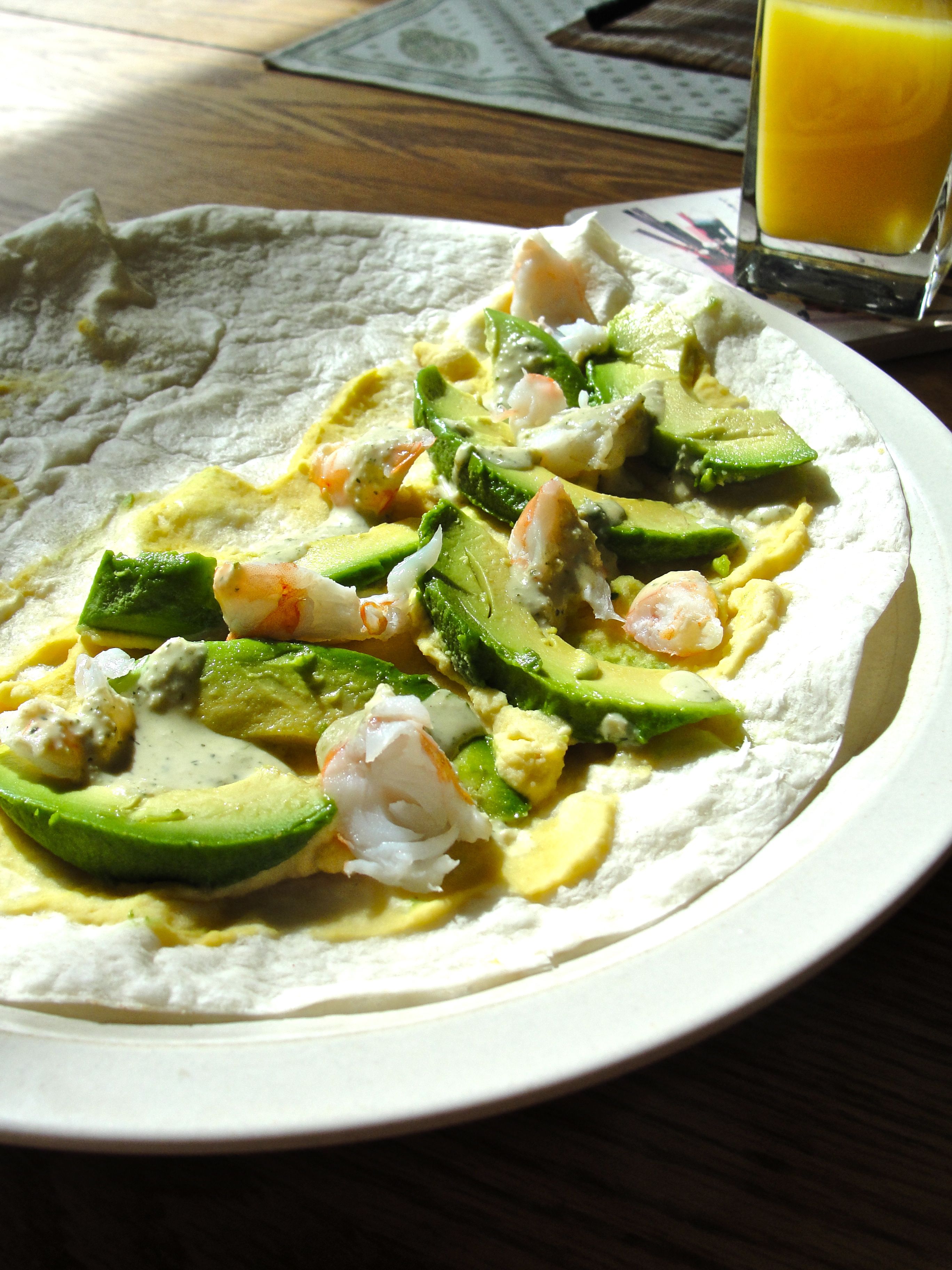
With some left-over grilled shrimp and dipping sauce, I made this delicious quesadilla for a quick breakfast.

It is simply hummus, cooked shrimp cut to bite-sized pieces, ripe avocado, and a coconut milk-based Peanut-Lime Dipping Sauce warmed open-faced in a pan over medium heat until the tortilla reaches the desired crispness.
I wait to add the avocado at the end, since I prefer it unwarmed.

As it happens, hummus is commonly eaten for breakfast in its countries of origin.

Avocado & Shrimp Quesadilla with Coconut Peanut-Lime Sauce

Hmm, now that I think of it, since I substituted hummus for cheese, I guess it’s not a proper quesadilla.  How do I get away with this stuff?  Yay for fusion cooking!

I’ve been making quesadillas since I was a child, having been introduced to them by my California cousin.

Here’s a quesadilla-making tip: while I didn’t do it here, when warming the quesadilla in the pan, spread the ingredients, especially the cheese, over the whole tortilla, not just one half.  The cheese melts faster, and the other ingredients warm faster, so you’re less likely to over-brown your tortilla… and the melted cheese acts as an adhesive so you can still fold it over without having the ingredients falling off the “top” half.

Here’s the recipe for the sauce:

How to Grill Shrimp (in my humble opinion)

Grilling shrimp in their shells

I mentioned that last week was “shrimp week” for me… so, you’re going to get a total of four posts on the subject, and I’m catching up now on this pleasantly rainy sunday. :-)

This weekend past, friends had another great Bring and Braai, i.e., a South African-style “pot luck” grilling party.  My contribution was two pounds of ~20 ct. large, frozen shrimp, for $13/pound.

When grilling shrimp, I’ve learned a great technique: grill the shrimp, whole with tails, legs, and shell intact.  They should be unfrozen and will cook in a few minutes and you just need to flip them once.  Of course individual shrimp could easily fall through grill grates, so skewer them or use a grilling basked, as shown in my photo above.
While I didn’t do it here, it’s best to cut a long slit down the back of each shrimp – this makes them easier to peel after cooking.

The advantages of this method are:

  • First and foremost, the shell keeps the moisture in.
  • The shell keeps the shrimp from sticking to the grill; no oil is necessary.
  • With the shells intact, shrimp achieve beautiful color.
  • There’s much less work when preparing them…

The further advantages (some might say disadvantages) of this method are:

  • You see the shrimp as it really is.
    (Well, sans head, as they’re most often sold in the U.S.)
    I don’t have much patience for people that don’t want to know what they’re eating.
    Animals have legs, tails, bones, and heads, and (sometimes) cute faces.
    If you don’t like being reminded of that, eat tofu and leaves instead.
  • The “work” of peeling the shrimp can be passed on to whomever is lucky enough to eat them.
    And look at the reward you get for merely peeling one large shrimp.
    Sounds like a good deal to me. :-)
    Besides, we are making our food too convenient to eat, e.g. boneless chicken wings. You’ve heard of “slow food?” I propose “slow[er] eating.”

Oh, and maybe you’re thinking, “Dave, umm, those shrimp aren’t deveined; yuck.”
That’s right, they’re not (above); the digestive tract is sometimes intact. As long as shrimp are thoroughly cooked, deveining is really a matter of aesthetics. Of the shrimp I ate, perhaps 8 total leftover, only one definitely needed deveining… which I did before eating it.

When I was buying the shrimp, the employee working the seafood counter inquired, “How are you going to cook those?” When I told him, he whole-heartedly agreed that is the best way to do it and we bonded over our shared “wisdom.” He also asked, “Aren’t you afraid it’ll freak out some of your guests?” To which I replied, “If it does [freak them out], that’s just all the more for the rest of us.”

Anyway, if you prefer to devein shrimp, go for it – the grilling method works the same, and it’s easier to remove the shell that is cut down the back.

Grilling deveined shrimp with shell intact

I more often use deveined shrimp anyway as raw shrimp are often sold deveined (in the U.S.). Deveined shrimp do have their own aeasthetic appeal, for instance, as they sometimes splay open in a soup, such as Tom Yum Goong.

To accompany these large peel-and-eat shrimp, I prepared two dipping sauces, roughly according to these recipes:

The coconut-milk based Peanut-Lime Dipping Sauce was probably the more popular, but both are quite good. You’ll see me reuse the latter sauce in my next two posts!

Chorizo & Chips Huevos Rancheros

Chorizo & Chips Huevos Rancheros

I’m not a “breakfast is the most important meal of the day” kinda guy. I don’t often eat breakfast, owing to the fact that I start the day later than most of you. :)
But, if I’m not going to have lunch, a big breakfast is in order.

Here’s one of my huevos rancheros variations.
(Triple-Decker Huevos Rancheros is my pièce de résistance.)

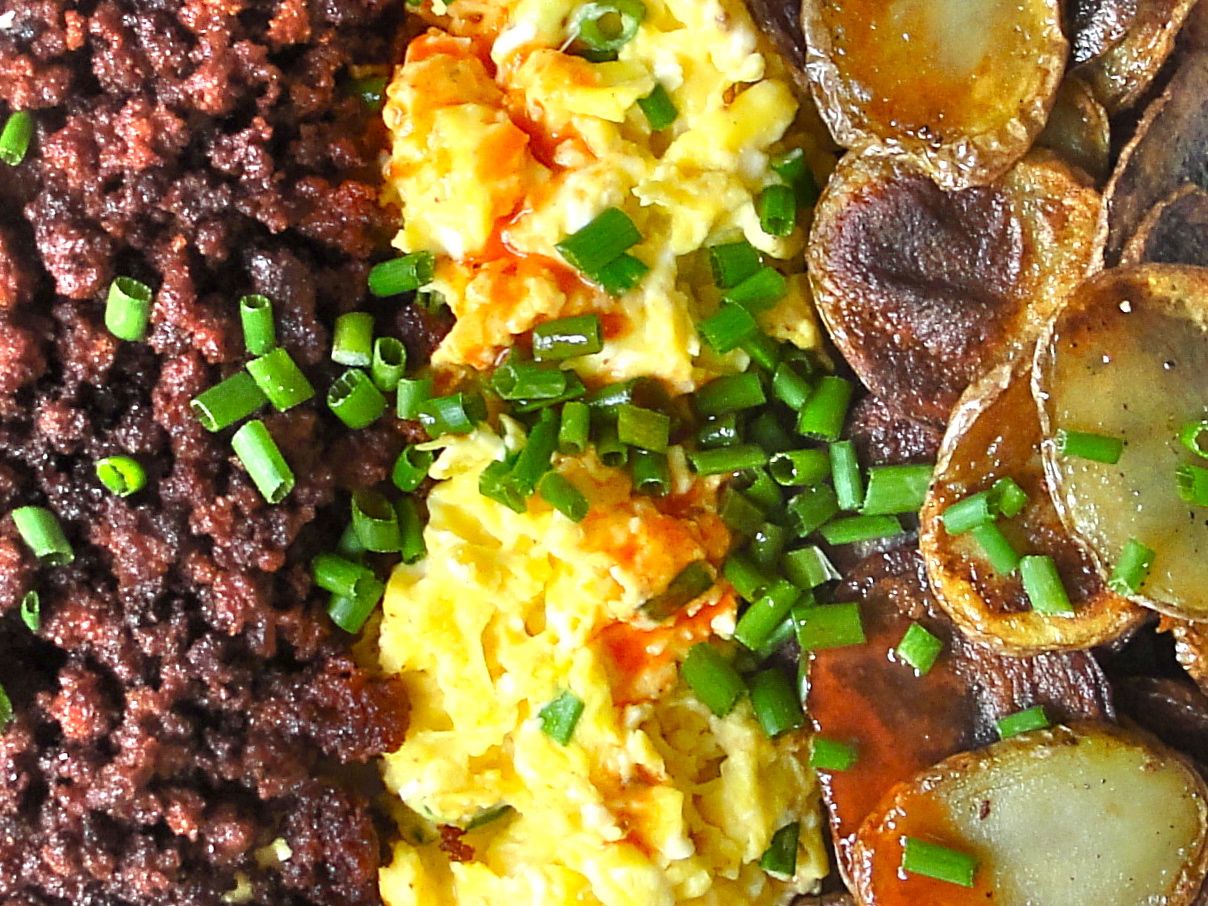
This morning, to serve just myself, I fried 3 sliced multi-colored small potatoes in canola oil, seasoned with salt & pepper and minced garlic at the end, so as not to burn the garlic.
Making potato chips in a pan is a bit tedious, but a texture somewhat crisp is achievable; use a big pan on medium to medium-high heat, and arrange the potato slices so that they don’t overlap much, and flip them periodically. A very thin, metal spatula works well.

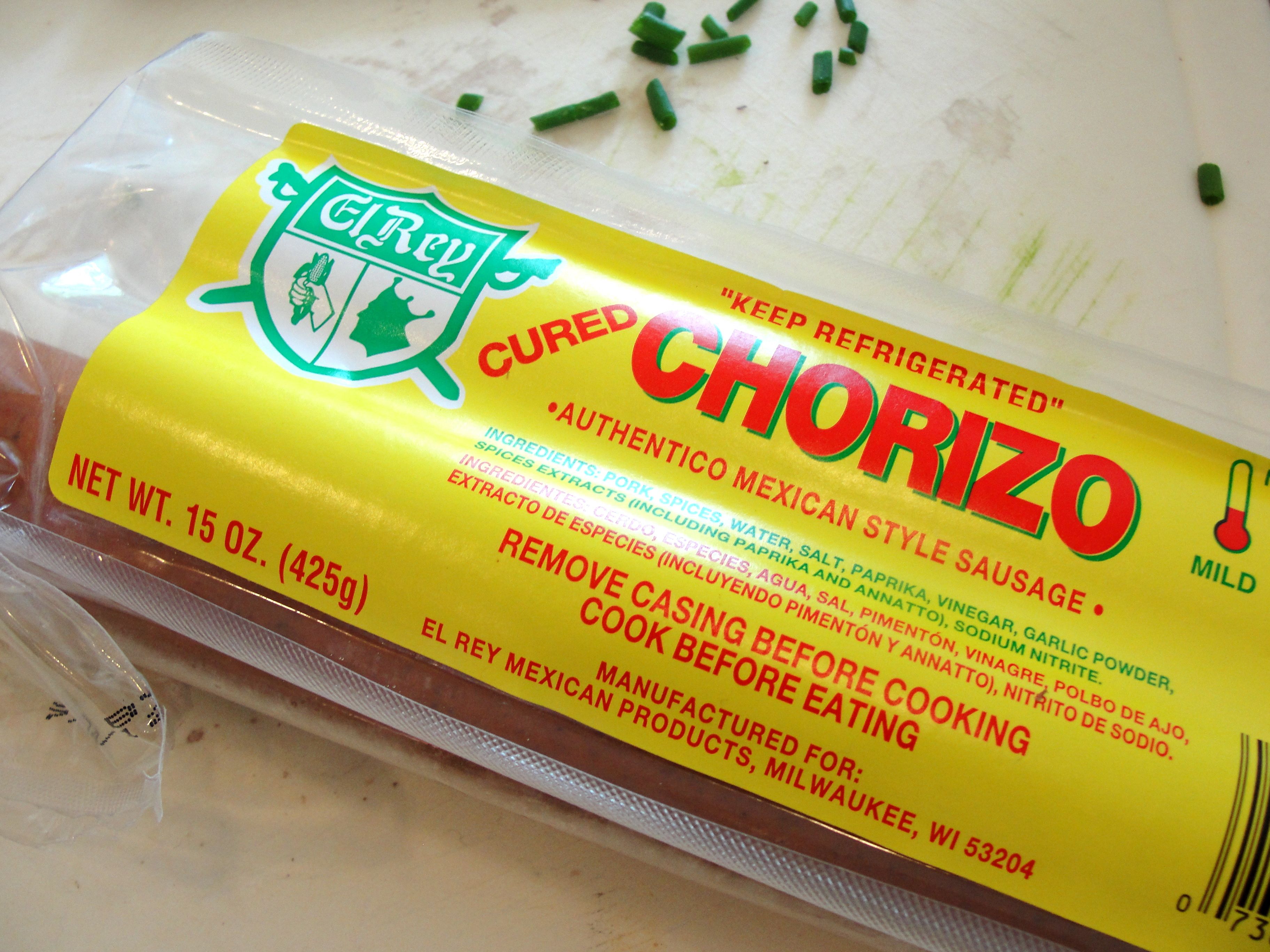
A mild, mexican (uncooked) chorizo.

Meanwhile, I fried 3-4 oz. mild mexican chorizo, crumbling it as it browned. While both the chips and chorizo drained on paper towel to soak excess oil, I scrambled 2 eggs in the chorizo pan, and stirred in a bit of sour cream and chives when the eggs were done.  Adding a cream or sauce to scrambled egg, just when done, lowers its temperature immediately to help prevent overcooking.

I served it topped with hot sauce and chopped chive.
How is it?  It’s hard to beat potatoes, eggs, and sausage for breakfast… or lunch. :)

Huevos Rancheros with Mild Chorizo & Garlic Potato Chips

P.S. If breakfast were a country, this would be its flag:

Flag of the Republic of Breakfast

Roasted Broccoli & Shrimp

Roasted Shrimp & Broccoli

Happy May Day!

This week is a busy one with my research work, so here’s an easy, delicious meal for you (and me). Actually, this is turning out to be “Shrimp Week” for me; this is just one of 4 posts I had in mind on the subject.

This broccoli & shrimp dish is a great find from The New York Times, c. 2009;  I’ve linked the recipe below.

For four servings, I bought 3 stalks of broccoli, 1 pound of 31-40 ct. raw, deveined shrimp, and 4 limes.

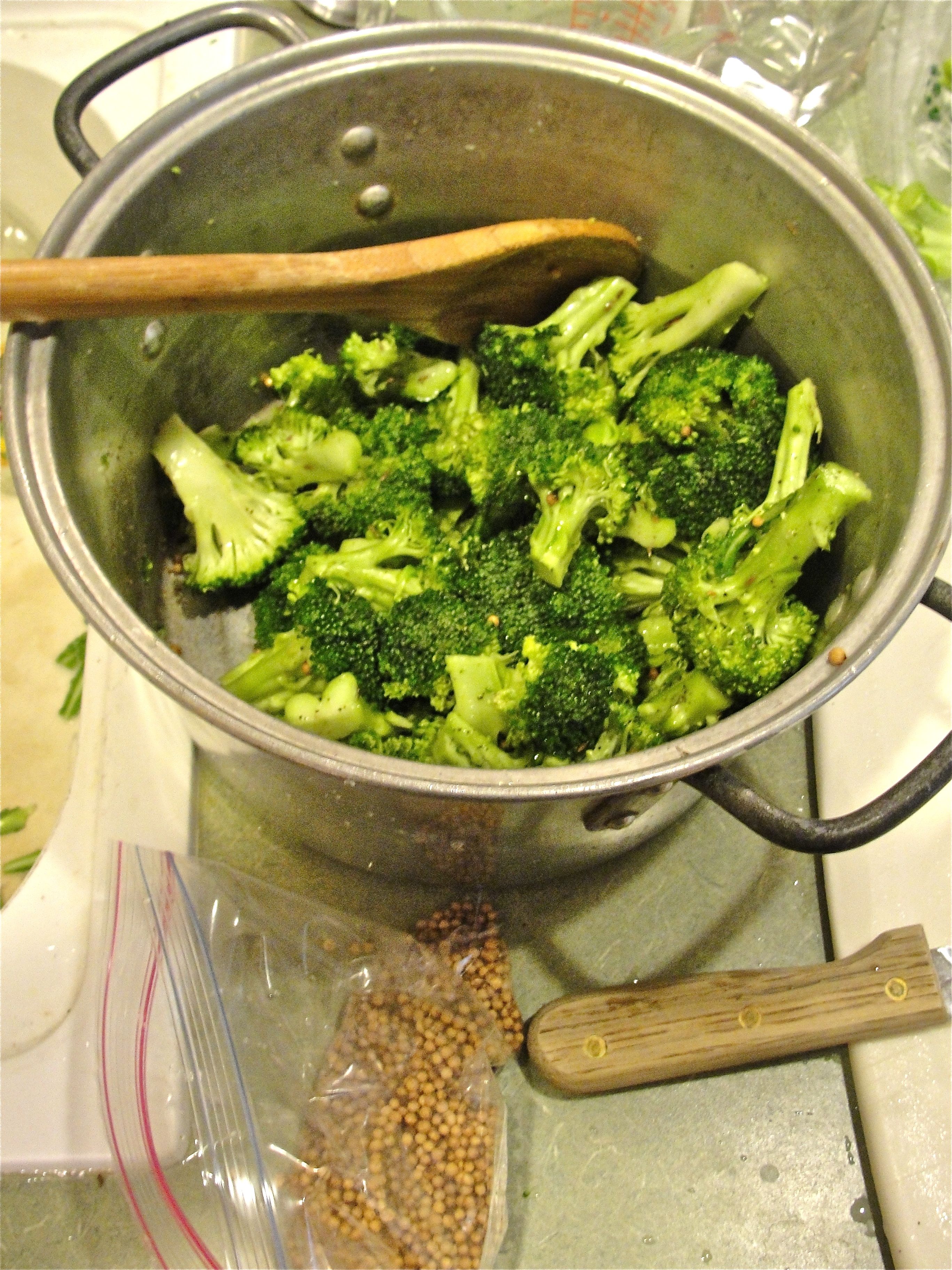
To prepare, cut broccoli into bite-sized florets.  You could use the chopped stem portion too, if you like (roasting them a bit longer than the florets), but I saved those for another recipe.  Toss the florets with olive oil (~2 T.), coriander seed (~1 t.), cumin seed (~1 t.), coarse salt, ground black pepper, and mild paprika.

Broccoli florets tossed with olive oil, coriander seed, cumin seed, salt, pepper, and mild paprika

Peel the raw shrimp and toss them separately with olive oil and the zest of 1 lime, salt and pepper.

Peel 1 pound of 31-40 ct. raw shrimp

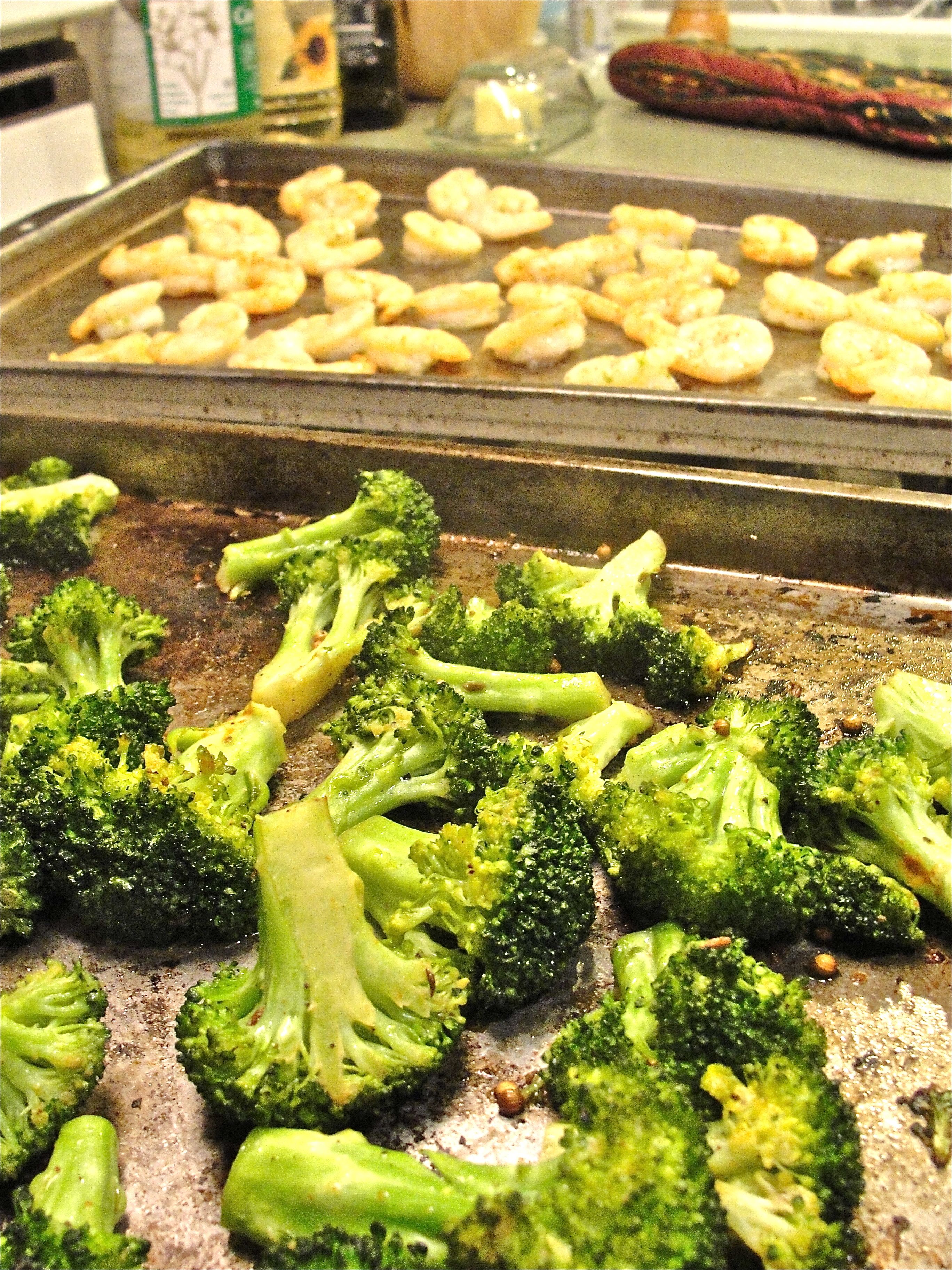
Spread the broccoli out on a baking sheet, and roast them, first on their own, in a 425° F oven for 10 minutes.

Broccoli and shrimp arranged for roasting

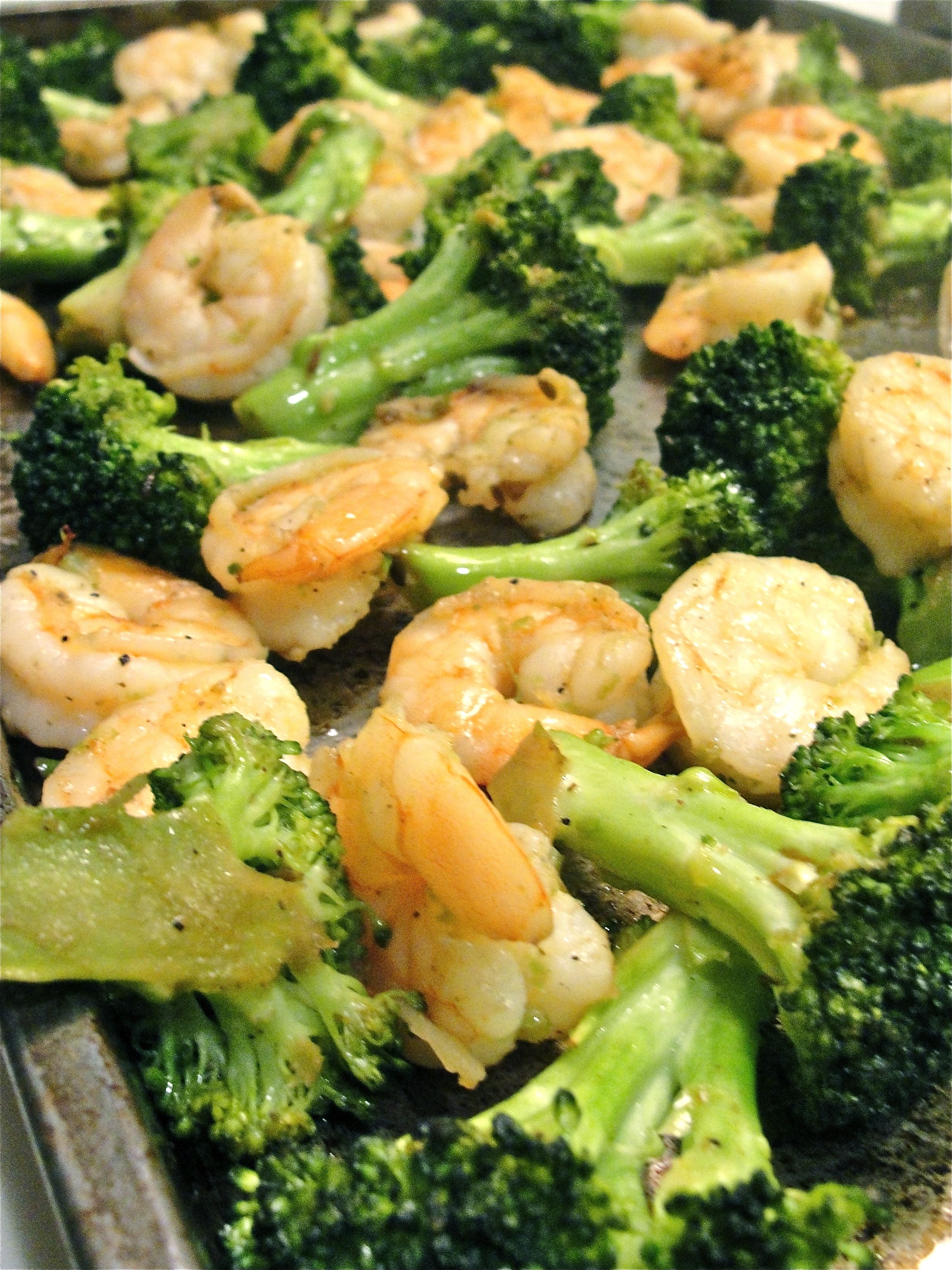
After the broccoli is partially roasted, similarly arrange the shrimp in one layer on a baking sheet and bake both the broccoli and the shrimp at 425° F for about 10 minutes, just until the shrimp are perfectly done.  You can combine them with the broccoli if the baking sheet is big enough for both in one layer with a bit of space between the shrimp and florets.

Perfectly roasted broccoli and shrimp :-)

When done roasting, drizzle the juice of perhaps 2-3 limes over the broccoli and shrimp (to taste).

I served the broccoli and shrimp atop sticky white rice with a lime wedge on the side.  Give it a try; it’s a perfect combination of flavors!

Roasted Broccoli & Shrimp with Rice

Oh, and don’t skip the coriander seed; it’s important!
I found coriander seed in a bag in the bulk(ier) spice section of my grocery store.  It was less than half the price, and more than twice the quantity, of that sold in a spice rack sort of jar.

Here’s the recipe from The New York Times; I substituted lime for lemon and mild Turkish paprika for chili powder:

Tea-Smoked Catfish

Tea-Smoked Catfish on Cucumber with Honey Tzatziki

Tonight I experimented with a Chinese cooking technique: tea smoking, that you can do indoors in your kitchen… if you want to stink up your house; ha ha, only kidding; my housemate arrived mid-smoke and said it smelled pretty good. :)

I learned about tea smoking on Chef Ming Tsai’s program, Simply Ming, perhaps a month or two ago.

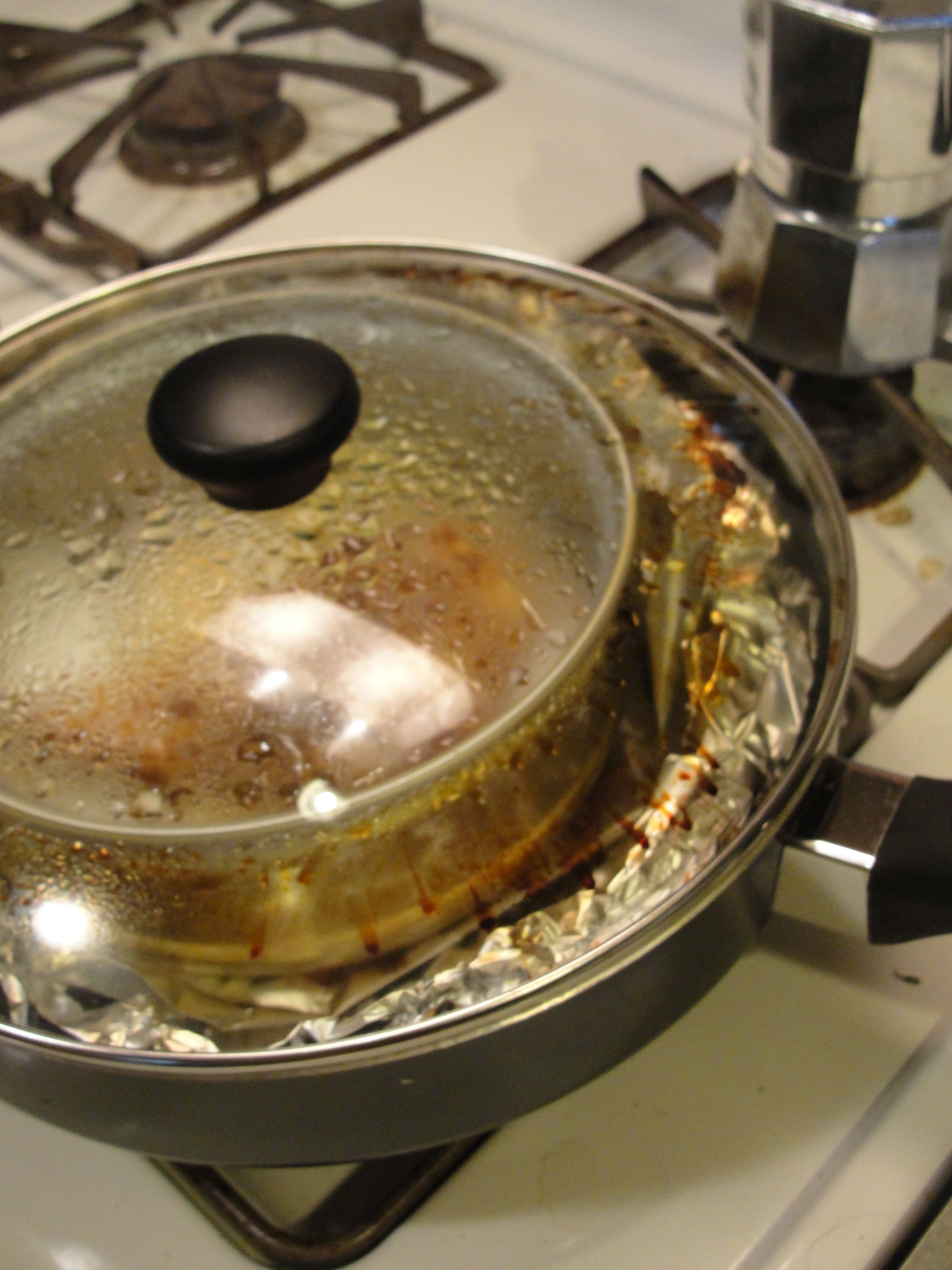
First, tea smoking typically calls for a covered pan with a lid, and a screen or wire grill that can fit inside to suspend the fish or meat above the smoking materials.  I decided to use an old pan that I no longer use, and should have discarded because the non-stick surface is flaking off.  I figured it was perfect for this application since the food doesn’t come in contact with the pan’s surface and it has a tight fitting lid.

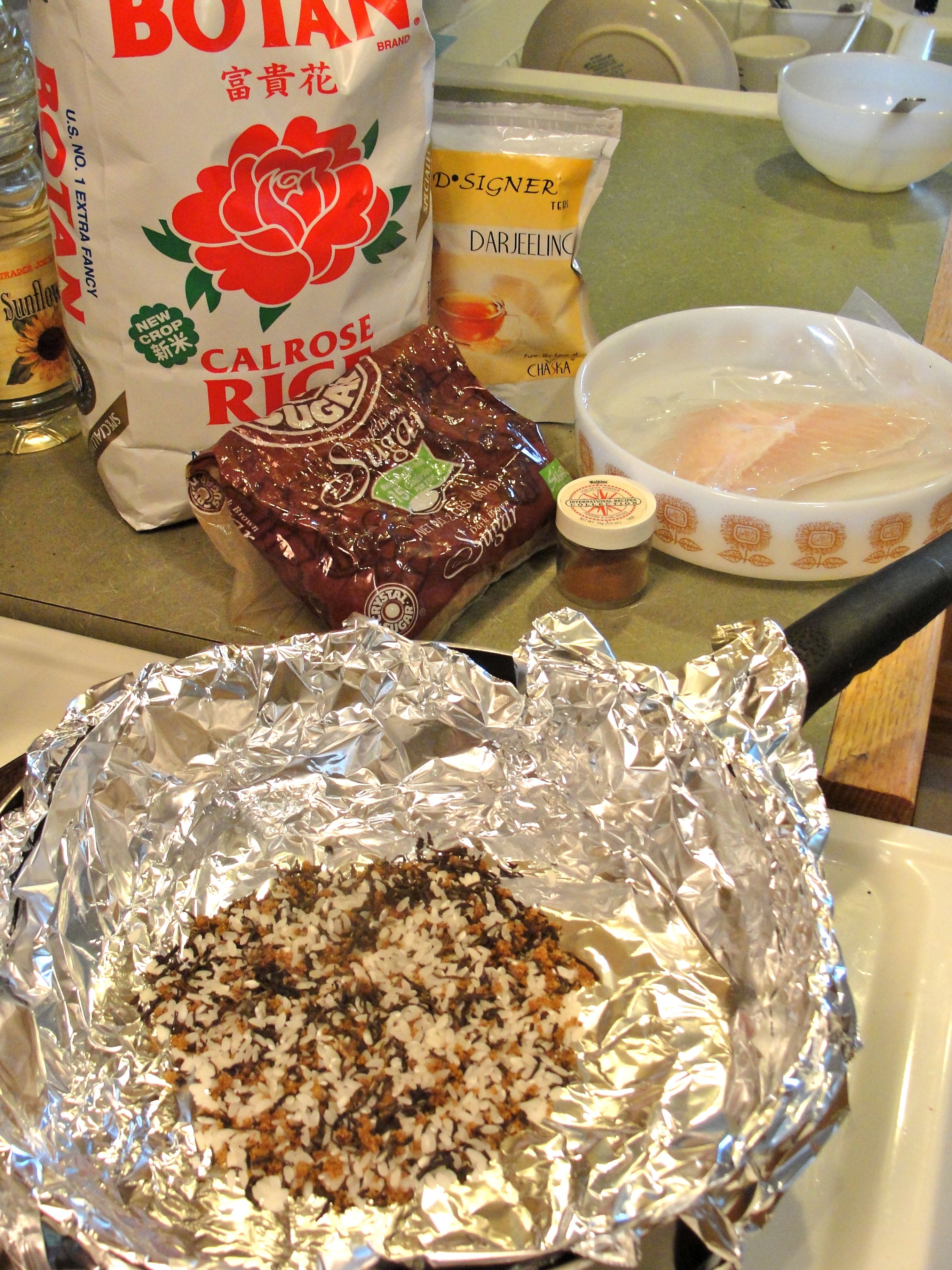
I lined the pan with two layers of aluminum foil, and placed the smoking materials in it: some uncooked Calrose rice, Darjeeling tea, brown sugar, and some tarragon leaves.  (The tarragon was once fresh, but that was a long time ago, so I thought cremating it was reasonable.)  I used Darjeeling, an Indian rather than Chinese tea, simply because that was the only leaf tea I had on hand.  I don’t see why you couldn’t use any tea, even ground tea leaves, though.

Ingredients and tea-smoking materials in a pan.

The fish I chose was an unusual kind of catfish, well, unusual to most Americans: it’s sold here by the name “Swai,” and is a typically farm-raised in the Mekong Delta region.  This fish is just a bit lighter and more flaky (less meaty texture) than U.S. catfish. While technically a catfish, it isn’t allowed to be sold by that name here because it competes with the U.S. farm-raised catfish.  If you’d like to know more about this increasingly popular and sometimes controversial fish, you can read more in my recipe for  Moo Shu Catfish.

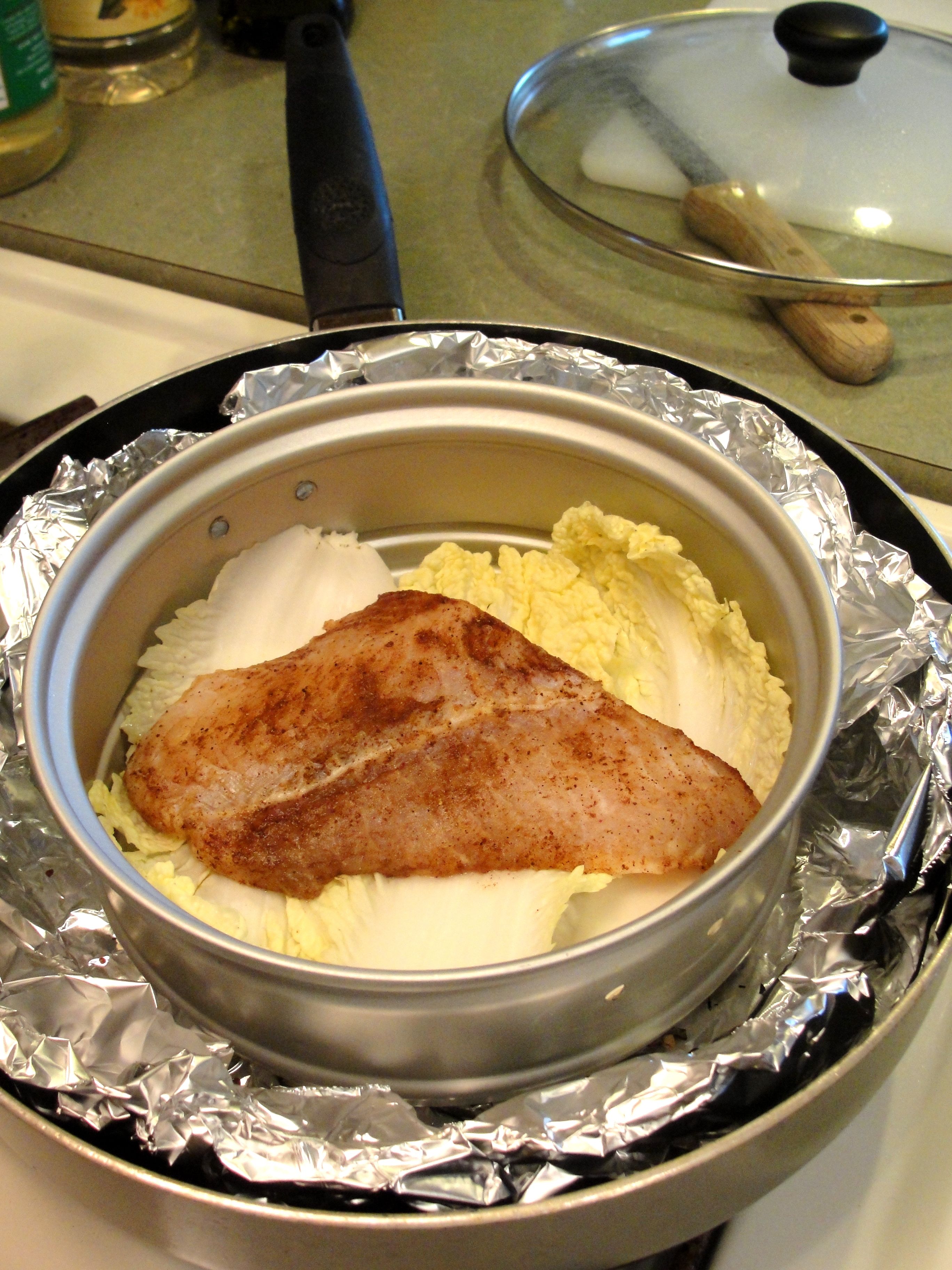
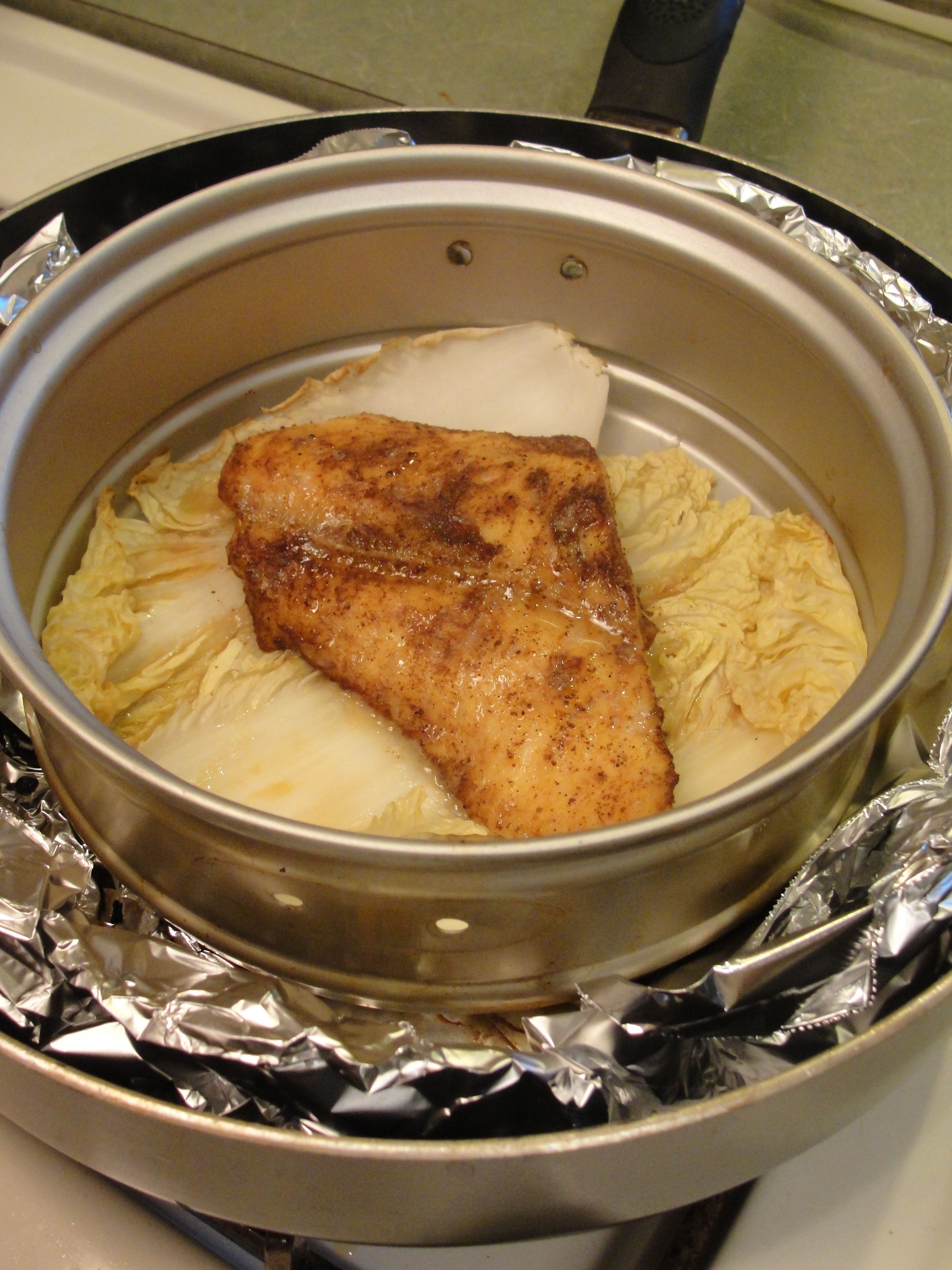
I prepared the thawed fish filet (3-4 oz., about 1/2″ at its thickest point) by rubbing it with some five spice powder and brown sugar and placing atop napa cabbage leaves in a steamer to be placed in the smoking pan, with another layer of aluminum foil between the steamer and the smoking materials so that they don’t adhere to the steamer as they burn.  (I didn’t have a screen or wire rack, so I improvised by temporarily removing the plastic handles from my rice cooker’s steamer basket.)

Swai fillet atop napa cabbage, ready for smoking.

Next, I set the burner to a medium-high heat, and when it began to smoke a bit, covered the pan with a tight-fitting lid, reduced to medium heat, and cooked for 15 minutes; luckily the lid was just high enough to accommodate the steamer basket.

After those 15 minutes, I removed the pan from the heat and allowed it to sit another 15 minutes, then uncovered it.

The tea-smoked and cooked Swai fillet.

I served the filet on lightly salted, peeled cucumber slices (overlapped, otherwise they can’t be picked up with chopsticks!) and topped it with a simple tzatziki-like sauce of greek yogurt, minced garlic, black pepper, salt, and a touch of honey.  While I used fresh garlic here, I’d suggest using roasted garlic as the sauce’s garlic flavor was a bit harsh for this mild fish.

Tea-Smoked Catfish

So, the verdict? The fish was moist and tender with a significant smoky flavor, but quite unlike that of wood-smoked fish. It’s a tasty option. I do think, however, I would have experienced the smoky flavor more genuinely had I not been essentially standing in or over the smoke for a half hour or more just prior to dinner. :)

I’ll experiment with different rices and teas, and perhaps tea-smoke a brined Cornish game hen before baking it.

Lastly, I see why some tea smoking demonstrations suggest covering everything with foil (including the lid). The smoke mixes with the moisture and can make for a couple extra minutes of scrubbing during clean-up.  It’s super easy to just discard the foil instead.

Here are the recipes I consulted:

Asparagus & Paneer Masala

Asparagus & Paneer Masala with potato and swiss chard, accompanied by Saffron Rice

It being springtime in my hemisphere, asparagus is de rigueur.
This dish is my melding of that favorite, oven roasted, and combined with a new challenge for me: paneer – a fresh, Indian cheese, that I hoped would complement the asparagus.

First, I prepared the paneer. As it happens, I signed up for a cheese-making class this coming weekend and was looking forward to trying my hand at a fresh cheese such as queoso fresco. Coincidentally, Tahmina post Paneer – 101 just in time for me to give it a try.  I prepared the paneer just as she described, using the juice of a bit more than 2 lemons, and similarly pressed it at room temperature under a cast iron skillet for about 3 hours before using it.  Once the paneer was kneaded smooth, I also added toasted cumin seed (1 1/2 t.) and salt (3/4 t.), that I’d crushed a bit with a mortar and pestle, and distributed it evenly throughout the paneer.

Paneer with Toasted Cumin Seed

I prepared the saffron rice, first, by soaking perhaps 10 saffron threads in a few teaspoons water for an hour or two.  Then I prepared rinsed jasmine rice in a rice cooker; when it was done, I separated half of it into a bowl, and thoroughly mixed it with the saffron and the yellow water in which it was soak.  Lastly, I combined the yellow and white rice, and mixed them until approximately evenly distributed.  (Chopsticks are a good choice of tool to mix rice if it is somewhat sticky.)

I prepared the masala roughly according to these two recipes: Squash, Potato, and Chard Curry and Subzi Paneer Masala.  I used a large red onion and 2 cans of diced tomato for the sauce, puréed in a blender with minced garlic and ginger.  I diced multi-colored small potatoes (brown, red, and purple) and partially cooked them in oil (left from frying the paneer) before adding them to the masala. I cut the chard stems into bite sized pieces, and the greens more coarsely, adding them sometime after the potato, since they need less time to cook.  Also, rather than fresh hot pepper, I used a bit of cayenne powder.

While preparing the masala, I roasted the whole asparagus spears under the oven’s broiler on a foil-lined baking pan, with olive oil, being sure to turn them occassionally and not allow them to burn.  (If you were to serve roasted asparagus as a side-dish, you’d likely add, salt, pepper; since I was preparing it to top the masala, I used only the oil this time.)

To serve, rather than mixing the asparagus, cut into bite-sized pieces, and fried paneer into the masala, I simply tossed them together, keeping them warm in the oven, and placed them atop the masala so that their textures and colors were retained.

All in all, I wasn’t completely happy with this dish.  The tomato and yogurt-based sauce didn’t have the smooth consistency nor the bright orange color that I expected and had seen, for instance, in butter paneer masala dishes at restaurants.  I used a low fat greek yogurt, rather than the usual [high fat] greek yogurt that I buy at Trader Joe’s;  that may have been part of the lack of smoothness to the resulting sauce.

Here are a few things that I learned:

  • Making fresh cheese is not difficult, but practice may be necessary to get the desired consistency.  Mine was a bit on the soft side for pan frying;  I should have squeezed just a bit more water from the paneer before pressing it.
  • To present the beautiful colors of vegetables such as various potatoes and rainbow swiss chard, don’t cover them in a tomato-based sauce.  Next time I think I will either use the potato and chard or the blended tomato sauce, but not both. :)
  • I used whole coriander seed, that I toasted lightly with the cumin seed.  In this dish, however, the whole coriander seed was a bit too much of an occassional flavor explosion, so I would grind it next time.  (I have had a shrimp and broccoli dish that is perfect with whole coriander seeds, so it works with some things and not others.)
  • Bright yellow saffron-rice and white rice mixed doesn’t provide quite enough contrast to be as visually dramatic as I wanted.  Some Indian restaurants must use red food coloring as well.

I was quite happy with the paneer, and now I do have plenty masala left-over for meals this week… back to work. :)

A Versatile Blogger Award for me?!


Yay me – I’ve been nominated for the Versatile Blogger Award!
Ah, one less thing before I die.

I’ve been busy with work this past week so you haven’t seen any new food from me; this post is a nice break.

I just started this blog last month, and I’m really happy to say I have connected with some talented and entertaining fellow bloggers… some of whom already seem like friends.

According to the VBA rules, I have some duties, so here goes:

The nomination and/or award is from Annie; thank you, Annie!
It made me feel warm and fuzzy.  Since the VBA is a kind of a pyramid scheme/chain mail, you can check out Annie’s blog: The Little GSP (and her acceptance speech.) I enjoy it and hopefully you will too. :-)

Next, I am to select 15 bloggers and bestow upon them a VBA nomination.
Wow, 15?  I haven’t been keeping up with 15 blogs lately, so I’ll start with my top choices and add more later.

My nominations are as follows; check out these great blogs!

  1. Tahmina for Kolpana Cuisine.  I use her recipes; what more can I say?
  2. Deb for Terrified Tastebud.  Follow someone who is in school for culinary arts!
  3. Katja for Katja’s Kitchen.  Lots of variety, clear and concise recipes that sound great.
  4. Kate for Summer of Pie.  Great savory dishes mixed amongst the sweets, and a creative baker who takes great photos.
  5. Pam and Jecca for Omnomalicious.  Comfort and other foods… bonus points for energy.
  6. Ribana for Cooking with …. Great photos, beautiful food.  I love it and I don’t even know Italian. :)
  7. TBD

Lastly, 7 things about me, in photos even:

  • I’m happily divorced.
    Some people are married, not that there’s anything wrong with that; I might do it again.
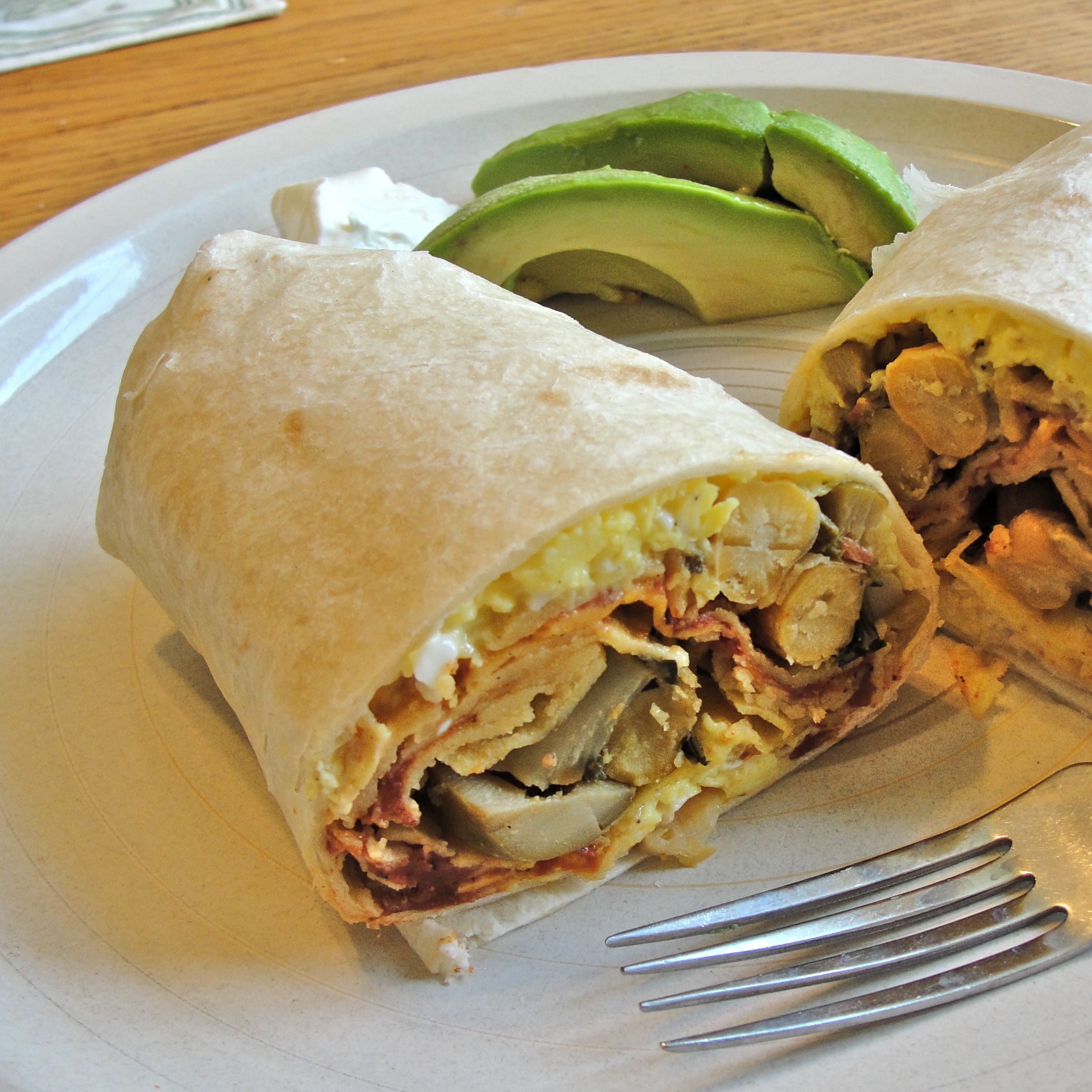
    Perhaps my style of cooking is “bachelor exotic.”  For instance, here’s my breakfast (and lunch) today: a burrito stuffed with scrambled egg and an enchilada, in turn, stuffed with rainbow swiss chard, chick peas and green olives… I think I’ll call it a “walking enchilada,” because you can pick it up. :)

    The Walking Enchilada

  • I was involved in a roller derby league and was a team mascot.
    (Hence my name “advoskater,” for instance, on Pinterest and YouTube.)

    AdvoSkater, i.e., me.

  • I’m a PhD candidate.  That means I’m almost done… ahem.
    Graduate school can be a pretty good place to have a mid-life crisis. :)

    In mathematics you don’t understand things.
    You just get used to them.

  • I’m an amateur visual artist.
    I especially enjoy figure drawing and etching.

    A life-drawing sketch (charcoal)

  • I’m a traveler.
    I’ve been lucky to have traveled quite a bit for my work and studies.
    When people ask which places I’d like to revisit, I say Romania (and Transylvania) is at the top of my list.

    A kick-ass Romanian 4×4 (an ARO M-461, I think)

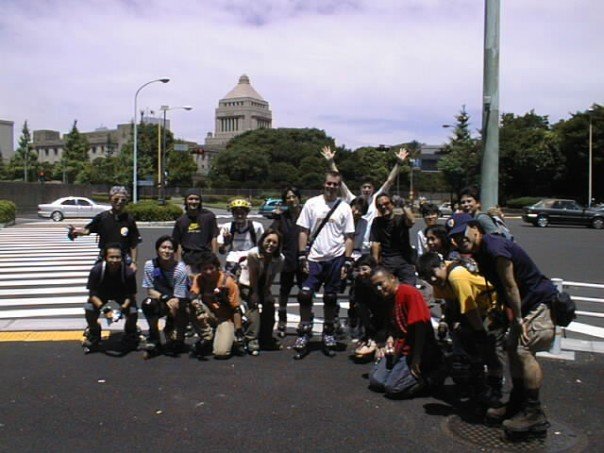
  • I’m an inline skater.
    I take my skates with me when I travel and have skated in many great cities around the world.

    Tokyo City Run.
    I’m big in Japan…
    relative to the Japanese.

  • I love great beer and beer festivals.
    “Once in a while you need a beer strong enough to make up for a bad day.”

    Happily at U Fleků brewery, Prague, Czech Republic.

That’s it; I hope you were entertained and that you follow the links to discover some great blogs and bloggers!

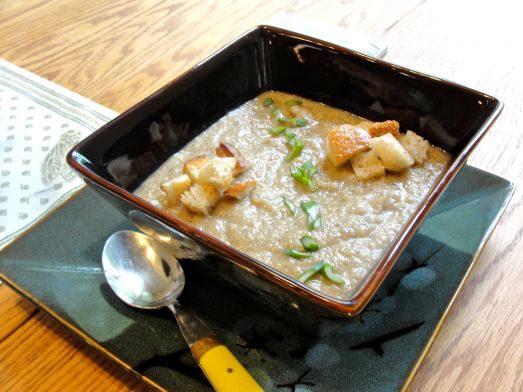
Shiitake & Carmelized Onion Soup

Shiitake & Carmelized Onion Soup

This past week was less than spectacular in my humble kitchen.  I created a weird tofu and bean thread noodle dish with a red wine-based sauce; hmm, it was just OK – I’m guessing no one wants purple tofu :-).  My other effort was a repeat: Pepper Steak, but this time I also made beef stock as a side-effect, owing to the fact that I had a lot of left over beef trimmings.

But, it’s a new week, so, today I’m doing something new (to me): a puréed vegetable soup!

My inspiration for this soup was the puréed shiitake mushroom soup at a local restaurant.  However, I didn’t have enough shiitake on hand, so I decided to mix it with onion, carmelized for sweetness to balance the earthy, but often slightly bitter, shiitake.

Shiitake & Carmelized Onion Soup Ingredients

Ingredients (yields 6 cups):

  • olive oil (~3 T.)
  • shiitake mushrooms (~2 oz., dried)
  • onion (e.g., yellow or other; I used 2 medium plus 3 small, cut lengthwise in strips)
  • soup stock (4 cups, I used homemade beef stock from trimmings boiled with mushroom stems, bay leaves, oregano, rosemary; fat separated)
  • garlic (4 cloves)
  • fresh ginger (1 thumb, minced, I used half of that shown in the photo)
  • salt (~2 t.)
  • ground pepper (~3/4 t.)

To prepare, first, reconstitute the dried mushrooms in a bowl of warm water.  I placed a small plate over them to keep them submersed; this will take about an hour.

Rehydrating Dried Shiitake Mushroom

Simultaneously, carmelize the sliced onion with 2 T. olive oil in a large pan or pot (8+ cup capacity; I used a 12-inch cast iron skillet) over low to medium-low heat, strirring often, for 45 minutes to an hour.  Be careful not to burn the onions, but rather make them tender and browned slowly, adding a bit more olive oil if it seems they are drying out.

Beginning to carmelize the onions and roast the garlic.

In the same pan, roast the garlic cloves until tender and the ginger a bit.  Since my garlic cloves were already peeled, I wrapped them in foil as well as the minced ginger, so that it could be easily removed when tender.
When carmelized sufficently, the onions should be moist, browned, and very tender; the garlic cloves should be tender as well.  (I removed the garlic from the foil to accelerate the roasting.)
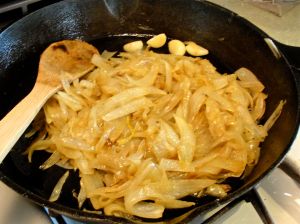
Carmelized Onion and Roasted Garlic

Next, place the rehydrated mushrooms in a colander and press out most of the absorbed water (to avoid excess water in the soup).

Rehydrated and pressed Shiitake Mushroom; save the water!

Coarsely chop the mushrooms and add them, along with the minced roasted garlic, and 2 cups soup stock to the pan with the carmelized onions and bring to a boil, cook for a short time (it seems to me that mushrooms, from dried, should be cooked), then remove from heat.
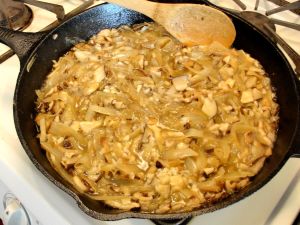
Carmelized Onion, Chopped Shiitake, Minced Roasted Garlic, and 2 cups stock.

Next, purée the ingredients into a soup, adding the minced ginger, ground pepper, salt, and about 2 cups more soup stock, which you can add progressively to acheive your desired consistency; you can use some of the water used to rehydrate the mushrooms, but be aware that it will impart a bit more bitterness to the flavor.

As with most soups, the right amount of salt is key.  Be sure to be conservative and taste test it as you add the salt.

I puréed the soup, somewhat inconveniently, in a traditional blender by adding some soup ingredients and stock little by little, progressively working up to its “liquify” setting.  Alternatively, you could purée the soup right in the pan or pot by using an immersion blender.

I served the soup topped with sourdough croutons, simply cubed fresh sourdough bread, pan fried in a little salted butter, and some finely sliced green onion, that was luckily growing out the top of one of my yellow onions that had been left in the sunlight on the countertop for too long. :-)

Shiitake & Carmelized Onion Soup

The result: delicious!  It’s got a creamy texture, but without dairy ingredients, and a nice blend of shiitake and sweet onion flavors, and just enough spice to keep you awake, from the ground pepper and ginger.

Alas, the way I prepared it isn’t vegetarian, but it could be done quite easily, of course.  Also, I used less than $2 of dried shiitake and onions as well, so it’s a nice, inexpensive, healthy soup!

Here are some related recipes that I considered:
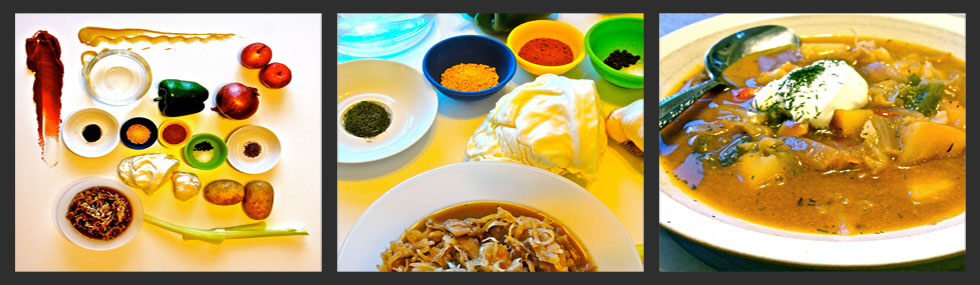
St. Paul Sandwich

Image

St. Paul Sandwich

Here’s a great sandwich that I had this morning instead of a typical breakfast sandwich: the St. Paul Sandwich; it’s essentially a hamburger made with an Egg Foo Young patty instead of a beef patty.  I was introduced to this sandwich on the public television program, “Sandwiches That You Will Like” some years ago.
Despite its name, the sandwich originated in St. Louis.

To prepare, first make the egg foo young like in my earlier recipe; this time I used leftover chopped Easter ham, thinly sliced napa cabage, and chopped baby bella mushroom.  (I used 4 “large” eggs for 3 patties.)

I served the patty with sauce on a small bun (another Easter leftover), topped with some julienned carrot and a bit of onion, a leaf of napa cabbage, a couple slices of roma tomato, and mayonnaise.

This is a tasty and unique sandwich for any time of the day, but it’s quick to prepare for breakfast or lunch from leftover egg foo young; the patties with sauce will keep for a day or two in the fridge and reheat well in a microwave.

Vegetable Pulao with Egg

Vegetable Pulao with Egg

This is the first dish that I’ve made from a fellow WordPresser’s blog, since I started my blog last month, specifically from this recipe: Vegetable Rice Palao.

This is a great vegetarian dish with a combination of spicy (especially with the quite hot Indian chili powder I had) and sweet (with the raisins, sweet corn, and carrots)!

I had most of the ingredients on hand, except I used a quality garam masala rather than cardamom and whole cinnamon; I put two star anise pieces in as well.  Also, *gasp* I didn’t have basmati rice, so substituted rinsed jasmine rice instead.  I cut the recipe to 2/3 (i.e., 2 cups uncooked rice, but the suggested amount of vegetables, raisins, and cashews), only because it’s quite a large quantity and I meant to eat this as a standalone meal, so I wanted a slightly higher ratio of vegetables to rice.  The suggested pairing with Egg Curry sounds great, but I was being lazy so just made some hard-boiled eggs, and buried them in the pulao to add some more protein to the dish after removing it from the heat.

Hmm, in hindsight, that’s probably too many changes to a desi chick’s recipe, but that made it fun for me; perhaps I have a problem following directions. :-)

Even with the reduced amount of rice, I got 6 full servings, some of which I served to friends with raita and garlic naan (Trader Joe’s).

Raita ingredients, stirred together:

  • greek-style plain yogurt, 16 oz.
  • cumin powder, 1/2 t.
  • garam masala, 1/2 t.
  • garlic, 3 cloves, dry roasted and minced
  • carrot, 1, peeled and finely julienned short pieces
  • cucumber, 1, peeled, seeded, and finely chopped
  • onion, 1, small yellow, minced
  • tomato, 2/3 can, fire-roasted, diced
  • saffron (perhaps 6 threads)
  • fresh lime juice, from one lime (or add progressively to taste)
  • salt (to taste)

Vegetable Pulao with Egg and Raita