Spicy Cashew and Basil Curry

Spicy Cashew & Basil Curry

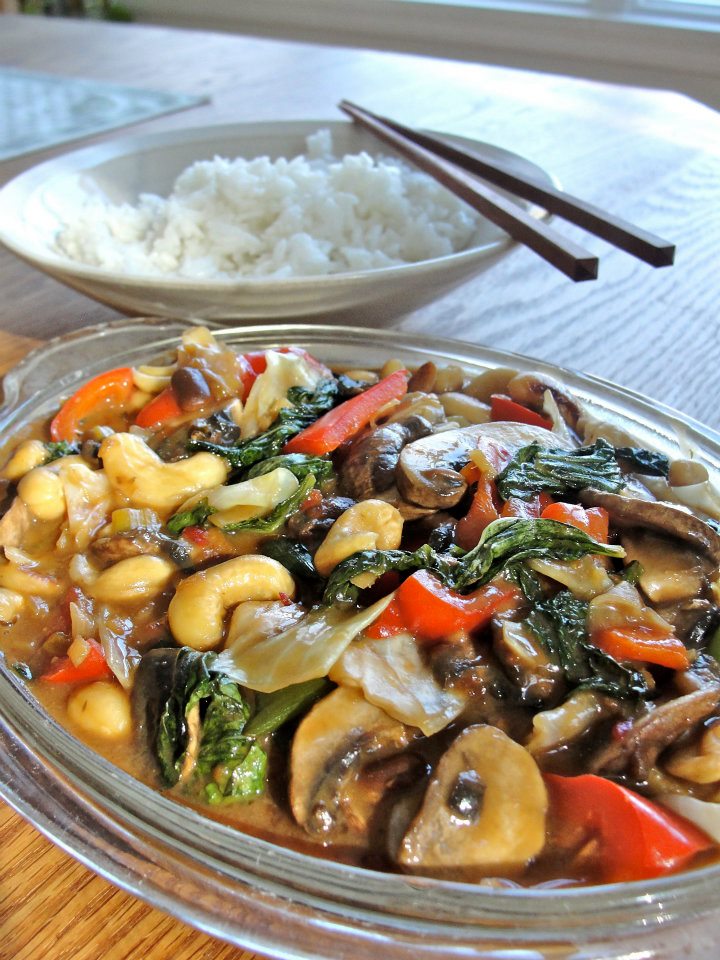
This is the first vegan dish that I’ve made… well, intentionally made vegan, anyway. So I didn’t use fish or oyster sauce. An inspiration for it is the whole basil curry at a local restaurant.

One unusual ingredient I used was tahini in the sauce; since tahini paste is just mashed sesame seed, I figured this is an alternative to sesame oil for flavor and may add substance to the sauce.

Ingredients: peanut oil, raw cashews, minced ginger, scallions, green cabbage, red bell pepper, baby bella mushrooms and whole basil leaves.

Sauce: orange juice, water, black bean paste, soy sauce (substitute tamari to be gluten-free), rice vinegar, palm sugar, tahini, chili garlic sauce, and cornstarch slurry to thicken slightly at the end.
(A similar sauce with coconut milk would be nice too.)

Here are some related recipes you might like:
“Spicy Beef with Thai Basil”
http://prettypeasrecipes.blogspot.com/2011/08/spicy-beef-with-thai-basil.html
http://thefoodaddicts.com/spicy-beef-with-thai-basil/
(I don’t know why they say the basil will turn black if you cook it… mine didn’t when I added it last with the mushrooms, and I wanted it wilted.)

Braised Chicken a la King

Braised Chicken a la King

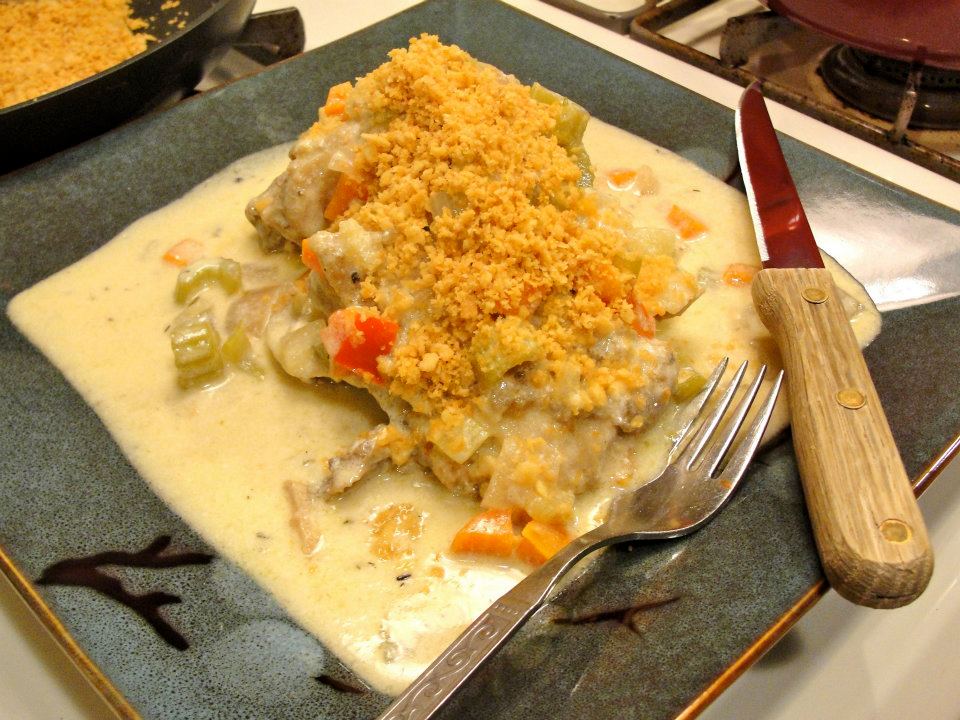
This dish is a modification of Chef Ming Tsai’s “Braised Sake Chicken a la Ming” recipe:
http://ming.com/foodandwine/recipes/simply-ming-season-8/braised-sake-chicken-a-la-ming.htm

I added red pepper and garlic to the mirepoix, added a couple bay leaves with the stock, and substituted 1 1/2 cups of Sauvignon Blanc for the sake and substituted sour cream, thinned slightly with milk, for the creme fraiche.

Overall, I rate it 3 out of 5 starts, i.e., I wouldn’t make it again as-is. The chinese mustard and wine are a nice improvement from your (my) mom’s Chicken a la King, but it is still reminiscent of that fairly mundane comfort food. The chicken is super tender when cooked this way though… the knife turned out to be just a photo prop. :-)

Fish Roe Fried Rice

Fish Roe Fried Rice

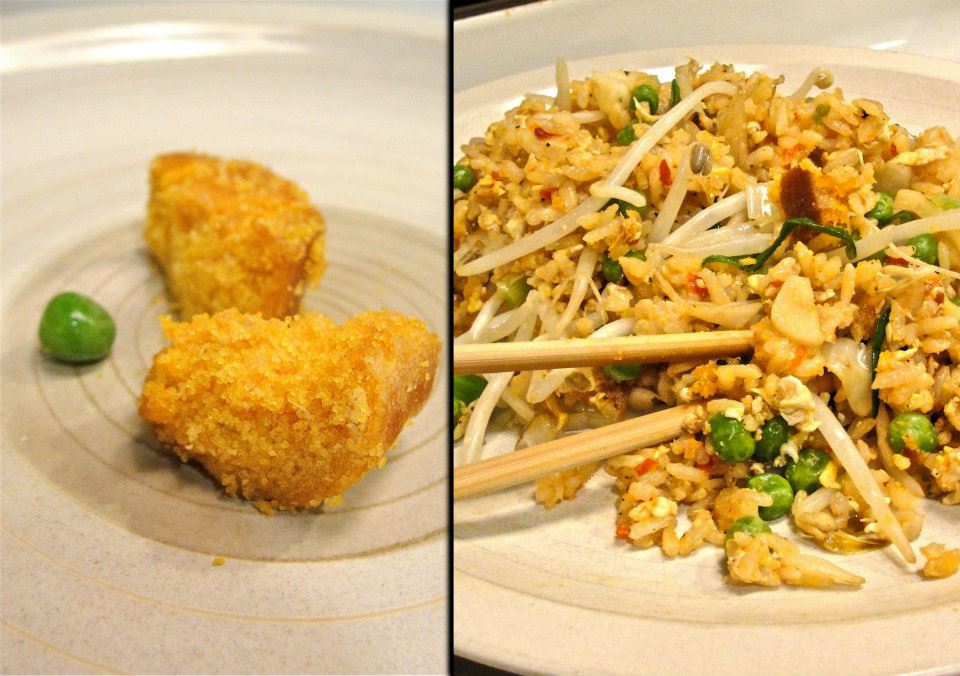
My awesome ex-housemate left some interesting things in the freezer… including pieces of grilled fish roe. (I had to ask her what it was; I had no idea.) She said it’s good with rice, I used just a bit (as shown on left, which was plenty for flavor) for this serving of fried rice. It thaws and disintegrates almost immediately, even in your hand, because it is porous and the eggs are so tiny. These broken pieces (left photo) are browned on one side, which was the outside of the egg mass, as seen in this photo of grilled fish roe:
http://i2.photobucket.com/albums/y15/odinchoy/japan275.jpg

Fried rice ingredients: canola and sesame oils, green cabbage, egg, scallion, sliced garlic, sticky rice, green peas, bean sprouts, soy sauce, fish sauce, rice vinegar, chili garlic sauce, black pepper, and grilled fish roe.

Moo Shu Catfish

Moo Shu Catfish

This is a delicious moo shu that I made with an asian variety of catfish.

To make this dish, pan-fry a light-flavored, white fish fillet in canola oil with thin strips of fresh ginger and a bit of chili garlic sauce, removing it as soon as it’s cooked and flakes easily.
In the same pan, deglaze with perhaps 1/3 cup thin sauce made of water, oyster sauce, honey, bean paste, and soy sauce and quickly stir-fry thinly-sliced cabbage, matchstick carrot, sliced scallion, thinly-sliced black mushroom, and bean sprouts. Remove while vegetables are still slightly crisp; flake the fish and add it to the mixture. (You might also add scrambled egg, as in many moo shu recipes.)
Serve wrapped with moo shu pancakes or in a flour tortilla as I did here, or with rice.

I bought the fish by the name “Swai”; it’s also known as basa, tra, panga (e.g., France) or pangasius, vietnamese river cobbler (U.K.?), and iridescent shark (although it’s a catfish, not a shark.) In the U.S., it is not allowed to be sold by the name “catfish” because it competes with U.S. catfish in the market.
http://en.wikipedia.org/wiki/Iridescent_shark
It’s a commonly farmed fish in the Mekong Delta region.

I made Ginger Catfish previously, and this is likely the sort of fish that would be used in Vietnam.

Here’s some more info on the fish, which has gotten some scrutiny as it has become popular world-wide with a commensurate explosion in farming of it in asia. Perhaps surprisingly, it has become one of top ten most popular fish in the U.S., due to its flavor and low cost. (For instance, I bought a 6.5 ounce fillet for under $2.)

“What is Pangasius? Only the 9th most consumed fish in the USA”
http://insidescoopsf.sfgate.com/blog/2011/09/13/what-is-pangasius-only-the-9th-most-consumed-fish-in-the-usa/

“Pangasius hypophthalmus”
http://www.fao.org/fishery/culturedspecies/Pangasius_hypophthalmus/en

Here is a documentary film, critical of its farming, c. 2008:
“Qu’est ce qu’un Panga ?”
http://www.dailymotion.com/video/xo87j_quest-ce-quun-panga_sustainable_dev

Pepper Steak and Tofu

Pepper Steak and Tofu

I made up this dish based on leftover ingredients from other recent meals; it is essentially a tasty combination of asian pepper steak and fried rice.

I used Angus Beef stew meat, thinly sliced. I also used tofu, cut into 1/4″ thick triangle-shaped pieces and fried in shallow peanut oil, so that just one side was browned. I like this restaurant-inspired way to prepare the tofu for its visual appeal.

The beef is sautéed in peanut oil with minced fresh garlic and ginger, then with coarsely diced green bell pepper and white onion. I also added some rice (prepared earlier), fresh whole basil leaves, and stir fried it, and mixed with a brown sauce of water, white wine, rice vinegar, soy sauce, oyster sauce, black bean paste, chili garlic sauce, and honey then reduced to desired consistency.

Rice Stick Noodle and Beef Sauté

Rice Stick Noodle and Beef Sauté

This dish is my approximation of a favorite a local noodle restaurant where it goes simply by the name “D8.” :-)

Stir fried in canola oil, ingredients are: sliced beef (I used relatively inexpensive Angus Beef stew meat), jalapeno slices, minced garlic, minced ginger, bean sprouts, scallion, egg scrambled in a bit of sesame oil, and combined with sauce consisting of fish sauce, soy sauce, oyster sauce, chili garlic sauce, rice vinegar, and honey, cooked until sauce reduced to desired consistency.

The noodles were extras, left over from my recent Pad Thai, and had been sitting in water in the refrigerator for a few days. (This seemed to neither hurt nor help; the noodles were just as they were after soaking only a half hour or so.)

This dish is a variation of fried flat noodles known as “Char Kueh Teow” as in the following recipes, popular in Malaysia and Singapore. It’s probably no surprise, then also, that it is somewhat similar to Pad Thai from adjacent Thailand, that is partially located on the Malay Peninsula.

“Fried Flat Noodles/Char Kueh Teow”
http://www.mykitchensnippets.com/2008/11/fried-flat-noodleschar-kueh-teow.html

“Char Kuey Teow (炒粿條/Penang Fried Flat Noodles)”
http://rasamalaysia.com/char-kuey-teow/2/

“Fried Flat noodle (Char Kueh Tiaw)”
http://www.chopstickdiner.com/index.php?m=recipe&c=show_recipe&recipe_id=96

Pad Thai and Tom Yum Goong

Pad Thai and Tom Yum Goong

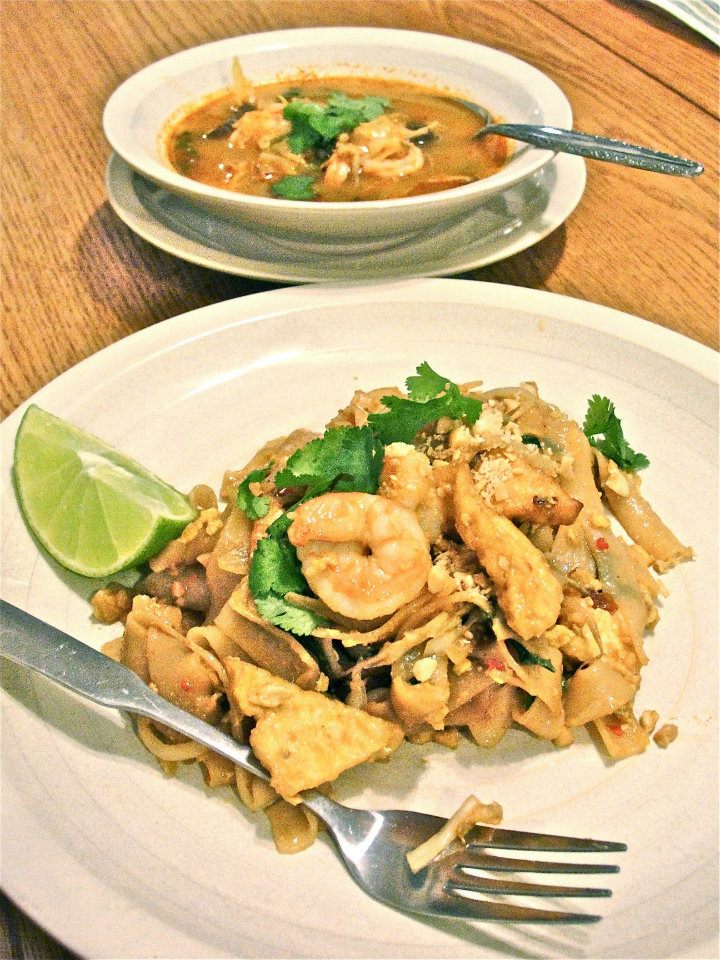
I’d not made a proper pad thai before nor had I deep-fried anything, so I decided to do these popular Thai treats for dinner.

The pad thai has shrimp and tofu – the firm tofu was cut into ~1/4″ thick triangles and deep-fried in peanut oil; other ingredients include: peanut oil, scrambled egg, sesame oil, rice noodles (banh pho), bean sprouts, thinly-sliced green cabbage, minced garlic, shallot, scallion, finely-diced serrano pepper, crushed dry thai bird peppers, soy sauce, fish sauce, water, sugar, natural peanut butter, chili garlic sauce, lime juice, and chopped peanuts.
Served with fresh lime, chopped peanuts, and fresh cilantro leaves.

The soup was prepared simply using Tom Yum Paste from a jar (Lee brand), with sliced fresh black mushrooms, bean sprouts, chopped green cabbage, sliced jalapeno, minced garlic, shallot, shrimp, and topped with fresh cilantro leaves.

I consulted the following recipes for ingredient ideas.

“Pad Thai”
http://www.epicurious.com/recipes/food/views/Pad-Thai-380593

“Vegetarian Pad Thai”
http://www.epicurious.com/recipes/food/views/Vegetarian-Pad-Thai-240960

Twice-Cooked Pork

Twice-Cooked Pork

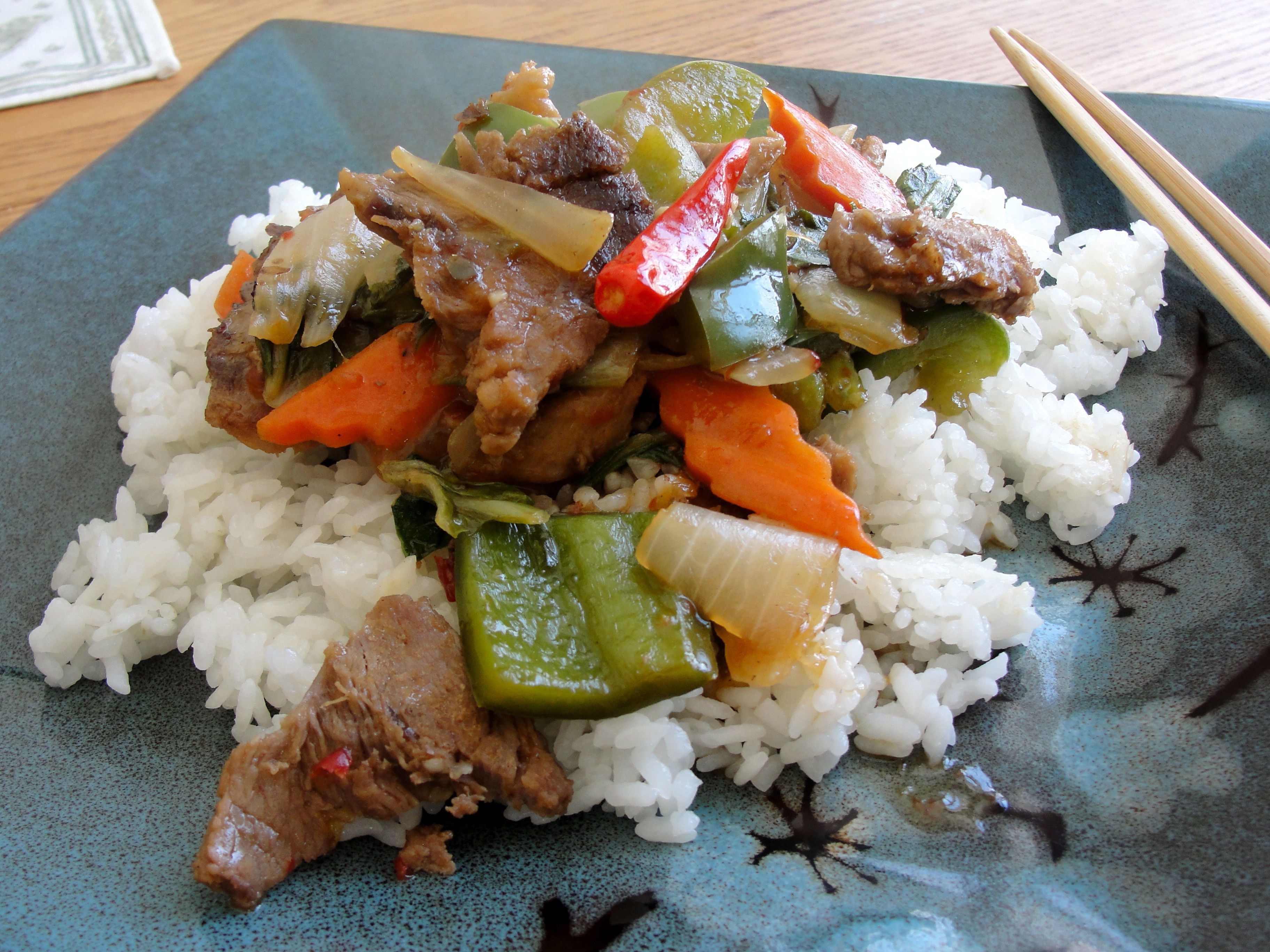
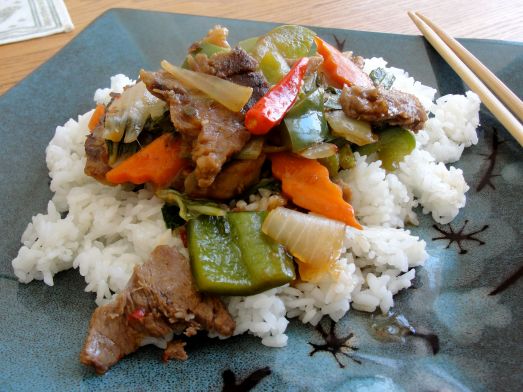
Szechuan Twice-Cooked Pork, a.k.a. Double-Cooked Pork, is one of my favorites and thankfully available at most every Chinese restaurant where I live. It almost always consists of sliced pork, cabbage, black mushroom, scallions, and a brown sauce that is a blend of sweet and spicy.
I added a bit more color with red pepper and carrot in this preparation of about 4 servings.

I’ve learned that twice-cooked pork is traditionally made with pork belly (but I’ve not seen that in american restaurants). I decided to use inexpensive, lean chops instead.

First, I boiled three whole pork chops in water with salt and pepper, cooled them (with ice cubes in the water), then thinly sliced them diagonally so that cuts are across the grain and so the slices can be wider than the thickness of the chop.

To prepare the sauce: start with about a cup of stock (I made the stock with some granulated chicken-flavor instant bouillon and the water used to boil the pork), add minced fresh ginger and garlic (4 cloves), coarse ground black pepper, sugar or honey (1-2 T.), soy sauce (2-3 T.), oyster sauce (4 T.), rice vinegar (1-2 T.), a dry red wine (1 T.), black bean paste (1 T.), chili garlic sauce (1-3 T.), and a couple teaspoons of corn starch. Be sure to taste-test the sauce for the right balance of sweet, sharp (vinegar), and spicy. There’s plenty of salt in soy sauce and bean paste, so don’t add salt!
This resulted in about 2 cups sauce before reduction, which worked well, since I like my pork saucy, like my … oh you know the joke.

To fry: in canola oil, stir-fry the pork slices to brown edges, coat with some sauce, then remove. Next stir-fry the vegetables, occasionally adding sauce slowly (to coat and reduce): carrot, green and red bell pepper, scallions, then sliced black mushroom (fresh or reconstituted), and then chopped cabbage and scallion greens. Return the pork to the pan, add remaining sauce and reduce to your liking.

Serve with sticky rice and enjoy!

I read a lot of recipes and watched videos while researching this one. Here are some of the most useful:

“Chinese Twice Cooked Pork”
http://www.youtube.com/watch?v=07L92tgRVfY
– I really like this guy’s amateur video… he seems like a kindred spirit. :-) He would have been fine if he’d just stir-fried the pork before putting in the vegetables that release moisture.

“Twice-cooked pork”
http://www.youtube.com/watch?v=rDhnq0v7ck8
– This chef shows an interesting stir-fry technique and a minimal recipe.

“Double Cooked Pork Slices”
http://www.tastehongkong.com/recipes/

UPDATE (March 2013):

I’ve made this dish many times, most recently with pork shoulder roast ($1.99/lb.) and skipped the mushroom and substituted white onion for scallions, simply because I didn’t have them on hand. It always comes out great.
Twice-cooked pork.

Twice-Cooked pork

Veggie Fried Rice and Wasabi Pea-crusted Tilapia

Veggie Fried Rice and Wasabi Pea-crusted Tilapia

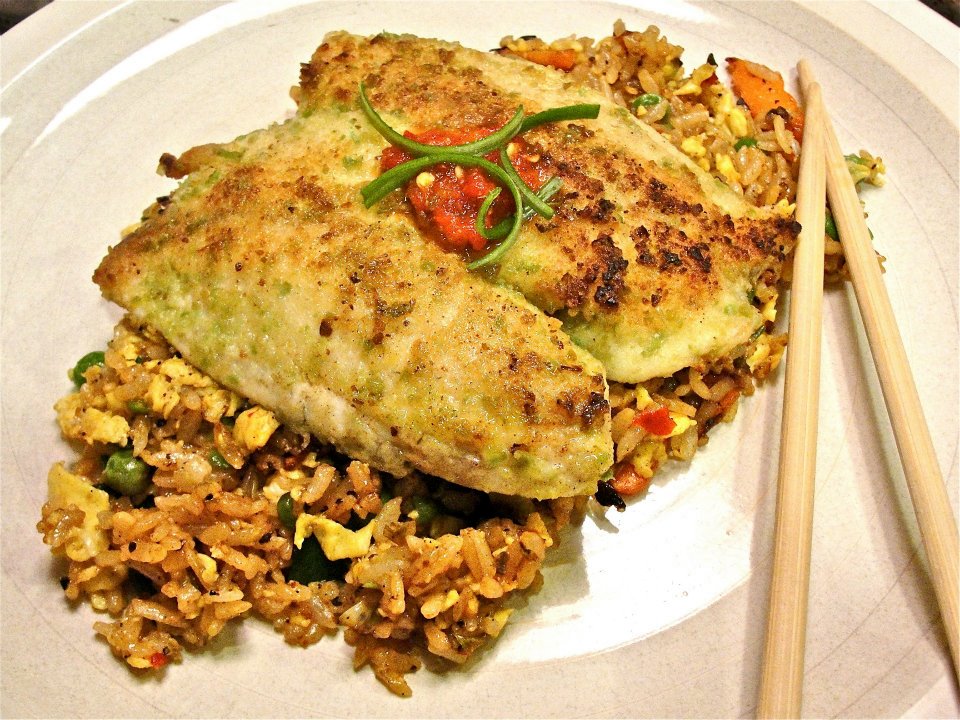
This is a recipe that I just made up, while getting over a learning and coding-induced headache this evening. :-) I’d been meaning to use dried wasabi peas in a dish, and found that many people online had also thought of it, such as to coat fish or to season popcorn.

Fish: small tilapia fillets, dipped in an egg wash and in a mixture of powdered wasabi peas (crushed with a mortar and pestle) and a bit of rice flour, then pan-fried in peanut oil.

Rice: canola oil, sliced carrot and scallion, sticky rice, green peas, soy sauce, fish sauce, rice vinegar, minced garlic, chili garlic sauce, black pepper, scallion greens, and egg scrambled (in advance, then added to the rice at the end) in a bit of peanut and sesame oils.

Surprisingly, the fish wasn’t particularly spicy. I added plenty of additional chili sauce when eating this one. Next time I’d add a couple other seasonings to the fish as well or just mix pieces into the fried rice.

Shiitake and Bok Choy Soup, Broiled Tilapia, and Sesame Sautéed Baby Bok Choy

Shiitake and Bok Choy Soup, Broiled Tilapia, and Sesame Sautéed Baby Bok Choy

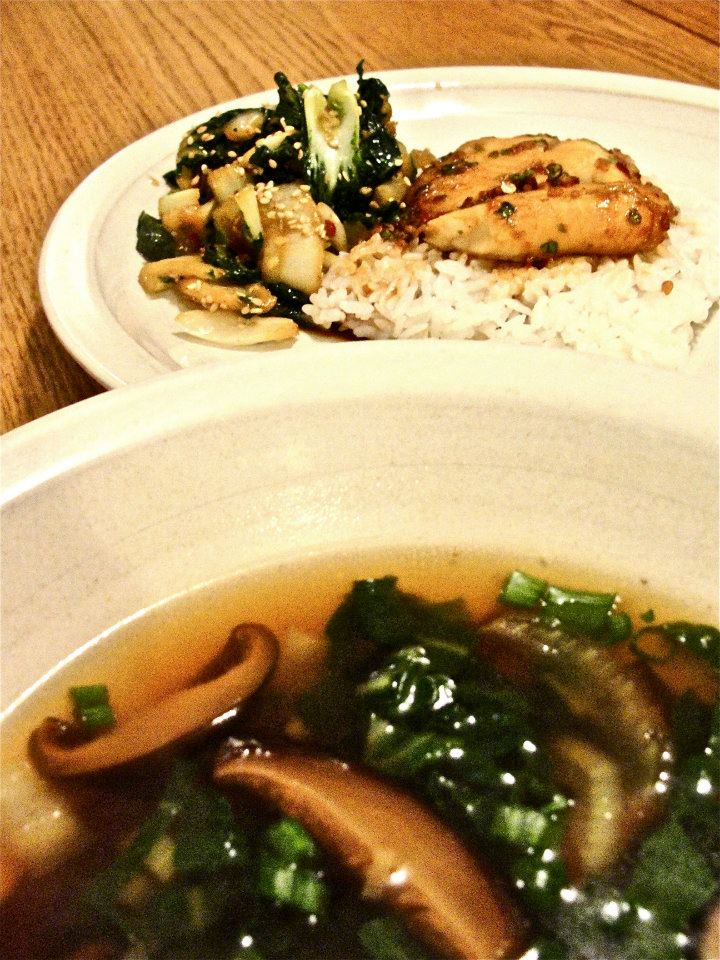
I found some dried shiitake mushrooms in the cupboard that my mom gave me some ten years ago (they were grown in Arkansas, of all places), so I decided to finally reconstituted them for this soup. To the best of my recollection, this is the first soup I’ve made from scratch. :-)

Here are the recipes I used for this healthy meal:

“Chicken, Shiitake and Bok Choy Soup”
http://www.epicurious.com/recipes/food/views/Chicken-Shiitake-and-Bok-Choy-Soup-103106
(The water used to reconstitute the mushrooms was used, in part, to make chicken bouillon.)

“Asian-Style Grilled Tilapia”
http://www.food.com/recipe/asian-style-grilled-tilapia-192282
(I substituted chili garlic sauce for red pepper flakes, added minced cilantro to the marinade, and served this atop sticky rice. While broiling, I reduced the marinade and served it over the tilapia.)

The sesame bok choy was prepared similarly to my earlier sesame swiss chard, but spiced up with a spoonful of chili garlic sauce.